![Fabric[K] Design](http://images.squarespace-cdn.com/content/v1/5846fe37ff7c5046fc8b98e8/1585703506724-ACFUCZ5FH3AGY64QWIFZ/FabricK-Design_Logo_1500x600_All+Green.png?format=1500w)

How to Choose What Neighborhood to Buy In
Among the neighborhoods you will evaluate in the search for property key characteristics of value will vary in quality. In some cases they may be slightly intact while in others they may be completely absent. Places like Detroit are unique because many neighborhoods lack a lot of these valuable assets. But these are precisely the neighborhoods that should be looked at more closely. By finding what’s missing in a community, you will have uncovered an opportunity to bring tremendous value somewhere it’s needed.
Re-Introducting the Neighborhood
Where to buy or invest? With the goal of building positive equity, this is another primary concern for future property owners, alongside operating costs of the property. To address this we need to take it back in the day a bit. One of the oldest and most effective indicators of a vibrant neighborhood is its ability to provide all the basic daily needs its residents will require within a 1/2 mile metric - the equivalent of a 10 (ten) minute walk. For thousands of years, humanity has used the ½ mile metric to create some the most valuable, efficient, and sustainable communities on Earth. Using this metric we can quickly analyze the value or potential value of a neighborhood based on three primary factors: Land Use Diversity, Transportation Options, and Close Proximity.
The first question you should settle before buying property, is “what is your level of commitment”? How long you are planning to own the property will determine the answer to this question. For the purposes of this conversation, we will focus on long-term ownership and equity building.
Diversity of Land Uses
Once you determine whether or not you’re in it for the long run, the next thing you want to look for is a diversity of uses - a collection of commercial goods & services, entertainment venues, civic resources, recreational amenities - immediately available to neighborhood residents. This signifies a healthy flow of cash within the neighborhood and also a self-sustaining community of people, commerce, and institutions at the local level. When critiquing a neighborhood ask yourself: Where is the grocery store?; Where’s the bodega?; Where are the schools?; Where’s the pharmacy?; Is there a barber shop? Where’s the restaurants? Where are the parks? Where’s the Library? Where’s the $2 coffee shop? Every neighborhood is different, but the formula stays consistent. A healthy mix of different and desirable land uses helps to raise the value of land around it - your property included.


Transit options
You also want to look at the neighborhood’s access to different forms of transportation. Access = Value. It may not seem like it but the simple ability to move from place to place is a very powerful action and will always be extremely valuable. Driving it seems will always be a viable transit option in contemporary society. However, it will play a more minor role in moving people as cities shift back to more sustainable modes of transportation like walking, biking, reliable buses, and light & heavy rail. When surveying your neighborhood look for transit options. Find the bus stops and where their routes connect to. Figure out where the bike lanes are and where they go. Take notice of the quality and character of the streets and sidewalks. If your city has one, look at the rail options and the ease to which you can access them. The more transit options your neighborhood has, the more likely it will have a positive effect on land values in the target area.


Close Proximity
This last point is a combination of the previous. If Access = Value, then Easy Access = Priceless. Think about how most Americans live their lives. According to the U.S. Department of Transportation on average each of us spend nearly two hours each day driving doing things like going to the grocery store, or work, or school, or to shop. In the process we waste precious time we can’t get back as well as hard earned money. Now imagine all it took was a 10-minute walk to get to the grocery store, instead of the usual 3o something minute drive. Apply that imagination to all your typical daily tasks, and I'd bet you'll discover a tremendous amount of time savings. Now, that recaptured time can be spent doing more of the things you enjoy with the people you enjoy the most. And that’s true value. When you have everything you need on the daily, inside your immediate surroundings, you are able to live a better and healthier lifestyle and you will certainly see this reflected in the value of land.


Create The Neighborhood You Want To Live In
Among the neighborhoods you will evaluate in the search for property, these three characteristics of value will vary in quality. In some cases they may be slightly intact while in others they may be completely absent. Places like Detroit are unique because many neighborhoods lack a lot of these valuable assets. But these are precisely the neighborhoods that should be looked at more closely. By finding what’s missing in a community, you will have uncovered an opportunity to bring tremendous value somewhere it’s needed. Within reason and comfort, find the missing links in a neighborhood and fill that gap. Build your home on that empty lot. Buy that two family flat, fix it up and rent it out. Bring the $2 dollar coffee shop to the empty retail building on the corner. Start the weekend Farmer’s Market that brings fresh quality produce to your community. Plant trees along the street to make it more enjoyable for walking. As these ‘gaps’ begin to fill in, the value of the neighborhood will commence to increase and you will better position yourself to see great returns on your financial and 'sweat' equity investments.

Detroit's "comeback" will not be solidified until its neighborhoods make a comeback as well. Who better to begin revitalizing these neighborhoods than the citizens themselves. Instead of waiting for some financial "savior" developer to bring salvation to a neighborhood, you be the change the neighborhood needs to see. If you don't, someone else will.
Set up roots in your neighborhood and make it what you want it to be - A place of value. And what’s more valuable than living in a place you helped build? Don’t wait for some magic developer to come and save your neighborhood. They’re not coming. You be that change. You be the neighborhood.
Real Estate, The Best Long Term Investment
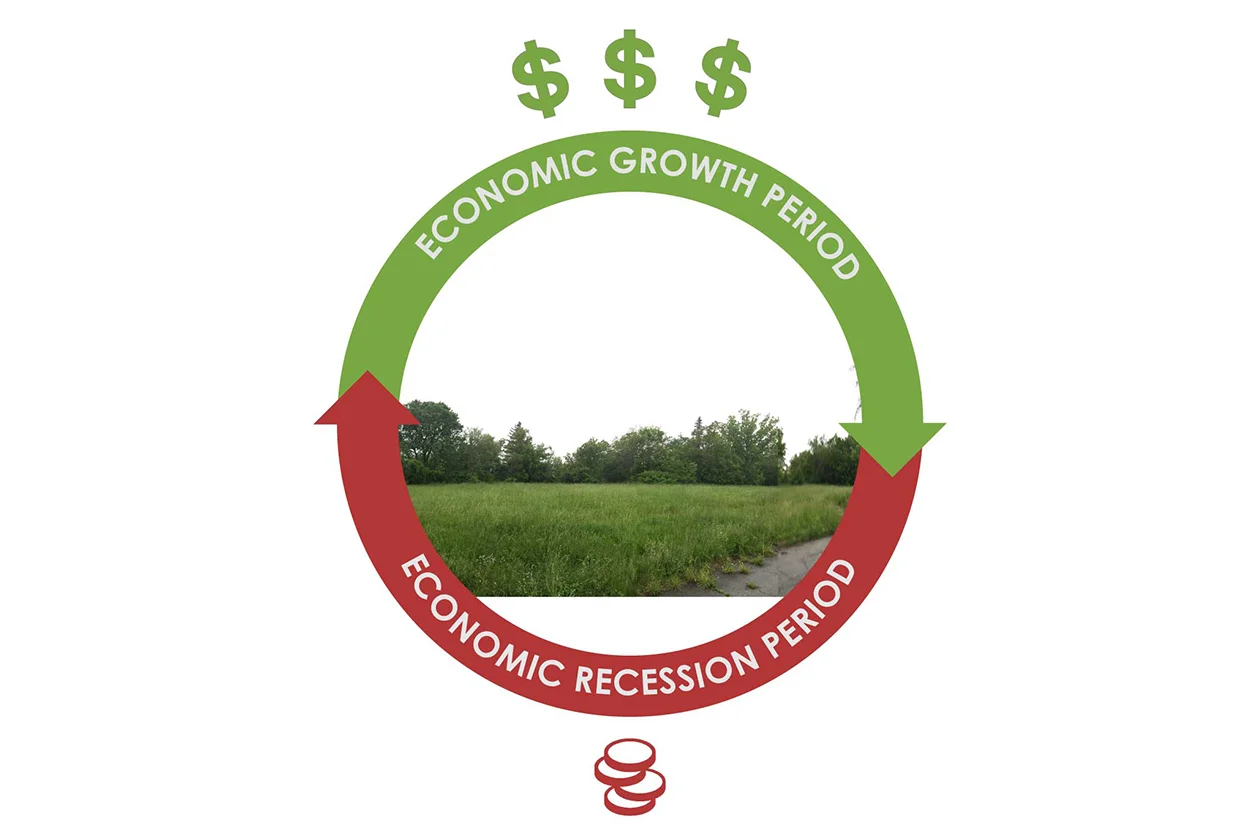
It’s important to remember that civilizations and their economies run through regular cycles of growth and recession. When the cycle comes back around for the upturn, you want to be the one standing there with the deed & title in hand. Now is the time Detroit. "Boss up and..." well, you know the rest.
We're Not Making Anymore Land

We’re not making any more land any time soon. In fact, we might actually be losing land mass due to rising sea levels in the coming decades. A great deal of the land we do have is virtually un-buildable or very difficult to build on because of its extreme terrain. This alone has made land extremely valuable throughout human history and continues to do so today. This desire is intensified in modern society with the unprecedented levels of land development seen across the globe. So for the most part, land is a non-renewable resource and those who own it will have a valuable asset at some point depending on the prosperity of an economy. It’s important to remember that economies and civilization run through cycles. When the cycle comes back around for the upturn, you want to be the one standing there with the deed.
Versatile Investment
Land is a very versatile investment. By doing the right research and finding capital you can do just about anything with it to create some needed value (code pending): turn it into a park; build a house on it; develop retail space on it; or any mixture of these. The important point is to do your due diligence first to see what the possibilities are in a specific jurisdiction. An architect can help you gather all the pertinent information. You can also develop the land into an income property. Many people build homes, apartments, townhouses, retail & office space on land and then rent that space for a profit to those in the market for such a space. In this case the land and the property serve as an enterprise, generating revenue for the owner while providing a valuable asset to their community. In contemporary neighborhoods, real estate products that have a high demand but low supply are Missing Middle buildings - structures in between single family homes and large 30+ unit apartment buildings. With these simple, revenue generating buildings types great neighborhoods were begun by everyday folks. They were private landowners developing property and then capitalizing on that space to build wealth for themselves and their family while nurturing the neighborhood. Through a good market study and an understanding of zoning laws, property owners can turn their land into a solid long term investment. It takes money to get going. But like the songwriter 'Stretch Money' says “It takes money to make money”.
More Stable Than The Stock Market. Yes, I Said It.

Most of you are thinking, “how can this be true when we just experienced one of the worst real estate housing markets in global history”. You are correct. But there is a key difference between land and stocks. When a company experiences economic loss and depression it runs the risk of closing its doors forever (as we witnessed in 2008). But when land goes through economic depression, it simply gets devalued. It never ceases to exist (unless it goes underwater). It may be worth pennies but it’s still there. Since it still exists, it forever has the ability to experience economic gains once an economy rebounds (as we are witnessing now). The bigger issue is being able to maintain the land and/or property through said depression which can prove to be difficult. However, if you can manage that until the next economic upswing, you’ll see some worth-while gains. But you MUST "flip" your thinking and play the long game.
It's a Long Term Game
I’ve noticed a contradiction. We are obsessed with the house flipping culture - the act of buying property, doing the bare minimal amount of improvements and then selling it. We even glorify it on HGTV. We do this while at the same time complaining about the conditions and services of our neighborhoods and communities. Flipping is not a bad thing when it's done correctly. It should be used as a capital raising strategy, building funds for other more substantial land developments to be built in the same neighborhood. And there is the operative word: neighborhood. Flipping a house is a good way to make relatively small amounts of quick money. It is much less effective at improving a neighborhood and the ‘flipper’ misses out on the true ROI (Return On Investment) which comes by playing the long game. What does improve a neighborhood is a commitment to place and an investment of time and money in both the individual property and its surrounding community. When the neighborhood improves, the land inside that community also improves - tremendously.

In Detroit as we speak, people from outside of the state who understand this principle are buying property cheap. A good deal are flipping. But there is equally a good deal of people that are not flipping. They’re setting up roots. They are committing the next 5, 10, 15 years of their lives to not just improving their land but also the neighborhood, because they foresee the economic upswing coming. They are fixing up their homes piece by piece. They are planting trees on the street. They are cleaning out the alleyways. They are cutting the grass on their lawns and the lawns of unoccupied adjacent properties. They are buying the abandoned corner store at the end of the block and turning it into a record shop, or market, or coffee house. They are playing the long game. They are investors in neighborhoods and not buildings. This is how land equity and economic value can be achieved. Our only wish is that people who have lived in the city for generations realize this as well and begin take advantage of the opportunity before them along side the cohort of "New Detroiters". In order to improve neighborhoods, build wealth, and live better lives we need more commitment to place. We need more long term visionaries. People who are willing to invest in property for the long term and use a little elbow grease to make their communities what they need to be. It doesn’t happen overnight. But over time you will see returns on your investment and you will have created a great neighborhood in the process.