![Fabric[K] Design](http://images.squarespace-cdn.com/content/v1/5846fe37ff7c5046fc8b98e8/1585703506724-ACFUCZ5FH3AGY64QWIFZ/FabricK-Design_Logo_1500x600_All+Green.png?format=1500w)

Real Estate, The Best Long Term Investment
It’s important to remember that civilizations and their economies run through regular cycles of growth and recession. When the cycle comes back around for the upturn, you want to be the one standing there with the deed & title in hand. Now is the time Detroit. "Boss up and..." well, you know the rest.
We're Not Making Anymore Land

We’re not making any more land any time soon. In fact, we might actually be losing land mass due to rising sea levels in the coming decades. A great deal of the land we do have is virtually un-buildable or very difficult to build on because of its extreme terrain. This alone has made land extremely valuable throughout human history and continues to do so today. This desire is intensified in modern society with the unprecedented levels of land development seen across the globe. So for the most part, land is a non-renewable resource and those who own it will have a valuable asset at some point depending on the prosperity of an economy. It’s important to remember that economies and civilization run through cycles. When the cycle comes back around for the upturn, you want to be the one standing there with the deed.
Versatile Investment
Land is a very versatile investment. By doing the right research and finding capital you can do just about anything with it to create some needed value (code pending): turn it into a park; build a house on it; develop retail space on it; or any mixture of these. The important point is to do your due diligence first to see what the possibilities are in a specific jurisdiction. An architect can help you gather all the pertinent information. You can also develop the land into an income property. Many people build homes, apartments, townhouses, retail & office space on land and then rent that space for a profit to those in the market for such a space. In this case the land and the property serve as an enterprise, generating revenue for the owner while providing a valuable asset to their community. In contemporary neighborhoods, real estate products that have a high demand but low supply are Missing Middle buildings - structures in between single family homes and large 30+ unit apartment buildings. With these simple, revenue generating buildings types great neighborhoods were begun by everyday folks. They were private landowners developing property and then capitalizing on that space to build wealth for themselves and their family while nurturing the neighborhood. Through a good market study and an understanding of zoning laws, property owners can turn their land into a solid long term investment. It takes money to get going. But like the songwriter 'Stretch Money' says “It takes money to make money”.
More Stable Than The Stock Market. Yes, I Said It.

Most of you are thinking, “how can this be true when we just experienced one of the worst real estate housing markets in global history”. You are correct. But there is a key difference between land and stocks. When a company experiences economic loss and depression it runs the risk of closing its doors forever (as we witnessed in 2008). But when land goes through economic depression, it simply gets devalued. It never ceases to exist (unless it goes underwater). It may be worth pennies but it’s still there. Since it still exists, it forever has the ability to experience economic gains once an economy rebounds (as we are witnessing now). The bigger issue is being able to maintain the land and/or property through said depression which can prove to be difficult. However, if you can manage that until the next economic upswing, you’ll see some worth-while gains. But you MUST "flip" your thinking and play the long game.
It's a Long Term Game
I’ve noticed a contradiction. We are obsessed with the house flipping culture - the act of buying property, doing the bare minimal amount of improvements and then selling it. We even glorify it on HGTV. We do this while at the same time complaining about the conditions and services of our neighborhoods and communities. Flipping is not a bad thing when it's done correctly. It should be used as a capital raising strategy, building funds for other more substantial land developments to be built in the same neighborhood. And there is the operative word: neighborhood. Flipping a house is a good way to make relatively small amounts of quick money. It is much less effective at improving a neighborhood and the ‘flipper’ misses out on the true ROI (Return On Investment) which comes by playing the long game. What does improve a neighborhood is a commitment to place and an investment of time and money in both the individual property and its surrounding community. When the neighborhood improves, the land inside that community also improves - tremendously.

In Detroit as we speak, people from outside of the state who understand this principle are buying property cheap. A good deal are flipping. But there is equally a good deal of people that are not flipping. They’re setting up roots. They are committing the next 5, 10, 15 years of their lives to not just improving their land but also the neighborhood, because they foresee the economic upswing coming. They are fixing up their homes piece by piece. They are planting trees on the street. They are cleaning out the alleyways. They are cutting the grass on their lawns and the lawns of unoccupied adjacent properties. They are buying the abandoned corner store at the end of the block and turning it into a record shop, or market, or coffee house. They are playing the long game. They are investors in neighborhoods and not buildings. This is how land equity and economic value can be achieved. Our only wish is that people who have lived in the city for generations realize this as well and begin take advantage of the opportunity before them along side the cohort of "New Detroiters". In order to improve neighborhoods, build wealth, and live better lives we need more commitment to place. We need more long term visionaries. People who are willing to invest in property for the long term and use a little elbow grease to make their communities what they need to be. It doesn’t happen overnight. But over time you will see returns on your investment and you will have created a great neighborhood in the process.

The Seductiveness of Imagery
Did you know that less than 20% of human communication is verbal? That means 80% of all human communication is not coming out of our mouths. By nature, humans are visual creatures. Before we developed advanced languages, we inferred our emotions, intentions and ideas with visual expressions using the parts of our body. Today linguistics are highly advanced systems - there are over 7,000 languages in the world today - but visual information is still the primary influencer of human behavior
Did you know that less than 20% of human communication is verbal? That means 80% of all human communication is not coming out of our mouths. By nature, humans are visual creatures. Before we developed advanced vocal languages, we inferred our emotions, intentions and ideas with visual expressions using the parts of our body and with drawings - symbolic images that represented a certain meaning. Today linguistics are highly advanced systems - there are over 7,000 languages in the world today - but visual information is still the primary influencer of human behavior and learning according to leading behavior experts and scientists. In architecture, visual information is supreme. Architects often create very evocative images of their designs as a means to influence clients, customers, and users. The seductiveness of the drawing is very powerful but can also be used for the wrong motives. It has the ability to hide poor design and influence transactions that are not worth their value.

When buying or renting a home, property or apartment, it's imperative that you look beyond the seductive factor and "modern" code words. Ask the right questions (the tough questions) that often have nothing to do with appearances. Don't get "caught up in the hype".
The "REAL" Estate trap
In the commercial real estate market developers, property managers and realtors will often show potential buyers a floor plan and a bunch of glossy images of the space they are marketing provided by the architect (or a rendering artist). These images are usually photo-shopped,"perfectly" polished, & pristine. They are often unrealistic and glamorized versions of what the property actually will be - a seductive strategy to get consumers to purchase or sign that lease. The same holds true for a property once its completed. It's stagged in a perfect visual manner to get you to make a purchase. It's all psychological. The strategy is not bad, but too often it's used to hide poor design, construction, space planning, or lack of space in general. A common maxim I like to use is that one must "look beyond the wallpaper". In other words, look beyond the fancy, seductive images and the shiny finishes and advanced appliances Instead, look at the quality of the spatial design and assembly. It's up to the consumer to investigate the space beyond what's immediately visible. Find a good realtor that will do more than try to sell you the shiniest thing on the market.
Good Drawing, Bad Design.
When I was in architecture school as an undergraduate I was a terrible designer. This was partly because I was concerned more with learning software than how to design. I'd use the latest software to do my projects and make them look photo-realistic (or so I thought). I was unconsciously using these programs to make the drawings look 'sexy' and cover up the bad design. When it came time to present, my studio professors were able to look right past the fancy programs and see just how poorly the design was. Then and there I learned a valuable lesson.
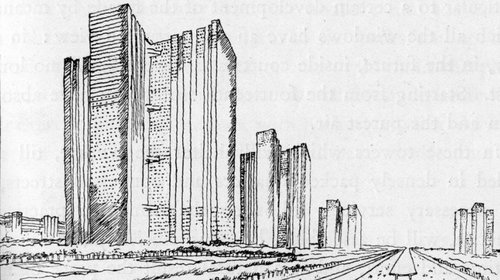
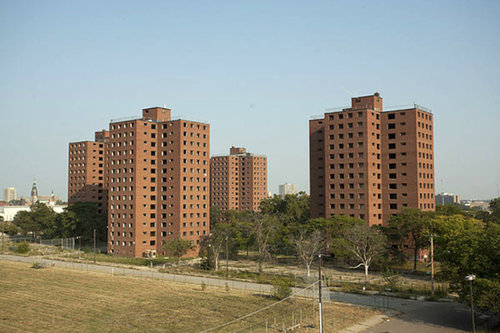
Now as a working professional I still go back to university to teach and critique student work. I see the seductive factor playing out in the studios today, especially at the undergraduate level. It's even more exaggerated now because of the increased variety and allure of digital programs available to students. They struggle the same way that I did, grappling with trying to do good design and make a sexy looking drawing. This happens in professional practice as well. Firms pump out fancy drawings of their sleek, curvy, and shimmering glass buildings manipulated to portray false, but seductive conditions. This is done to create a certain visual storyline for the viewer and often times used to mask an incomplete design or perceived undesirable features. Nonetheless, it is important for architectural students, architects, and patrons of architecture to recognize that good, competent and functional design is paramount, the 'sexy' factor is a secondary complement to good design.
Be Good, Then Seductive
The important lesson here is to simply be aware of the "Seductiveness of the Drawing". The allure of buildings and spaces that only look good on paper is very misleading. Sexy drawings are intrinsically not bad. And even I will agree that some times the designer should guide the conversation about a project by highlighting certain parts of a building. But these buildings must not only sell, they must also work - if we truly care about making quality environments. Details must be carefully thought out for proper assembly; context must be addressed properly; materials must be durable and used in the correct way, and much more. If architects (and students) put the same amount of concern they put in making seductive drawings, into designing simpler, well thought out, high quality stuff , the world would have many more great buildings.

It's important not just to LOOK GOOD, but also "BEY" GOOD. Take it from Beyonce.
To clients, consumers, and users of architectural products, look beyond the wallpaper. Question buildings and spaces beyond what you see on the surface. There might be some important aspects being hidden from you. Look beyond the facts and features, (square footage, energy efficient appliances, expensive finishes, etc.) and try to find the more personal benefits (comfort, quality of lifestyle, experience, functionality, etc)
To my fellow designers, we have a duty to provide good design, not just provocative images with no substance behind them. There is already a false stereotype that all architects (and designers) do is draw 'pretty pictures. Why feed into this? Why not show the world that we do a lot more by focusing our attention where it should be - on good all-around design for people. First function; then the flash and flare. As the old saying goes, "Everything that glitters, ain't gold".