![Fabric[K] Design](http://images.squarespace-cdn.com/content/v1/5846fe37ff7c5046fc8b98e8/1585703506724-ACFUCZ5FH3AGY64QWIFZ/FabricK-Design_Logo_1500x600_All+Green.png?format=1500w)

What is an Architect, Really?
Lawyers. Doctors. Therapists. Engineers. When thinking of these occupations, most have a good idea what each does. But when thinking of an architect that’s when things become of bit ambiguous. An architect is a generalist; a polymath; a “jack of all trades” so to speak. The architect is responsible for both the artistry and science of creating space and constructing the form of society. They do more than “draw pretty pictures”. For thousands of years they have been tasked with creating the vision for civilization and managing the complexities associated with designing and constructing the man-made environment.
In all honesty it’s a fair question. Of the major professions that require a licensure, architecture is the most unclear. Lawyers. Doctors. Therapists. Engineers. When thinking of these occupations most have a pretty good idea what each does.When thinking of an architect, that’s when things become a bit ambiguous. Begin to think of your own pre-conceived assumptions of what an architect is. Almost certainly it would be either a person who “draws” buildings or a person who “builds” buildings. Both descriptions are equal parts true and incorrect. But I’ll save that argument for later. In any case it’s best we start by detailing what an architect is,...for real.
“Players wanna play/Ballers wanna ball/ Rollers wanna roll/...”

The word ‘Architect’ originated in the Greek language as 'Arkhitekton'. Arkhi- meaning ‘chief’ and Tekton meaning ‘builder’, translates to “a chief builder”. The Latin progression of the word, 'Architectus', means “master builder” or a “director of works”. Notice there is no mention of anything relating to drawings. This suggests that architects have ancestral roots in building things rather than drawing them. For millenia this was the universal understanding of an architect’s role in bringing physical form to a society.

The monuments of antiquity were built from a combination of skilled and slave labor. This painting shows skilled Egyptian craftsmen quarrying, shaping, and transporting stones as well as making mud bricks. These ancient tradesmen were some of the first 'architects'.

Ancient monuments were often the visions of rulers and their "master builders". What we would call drawings today, did not exist in the time of the ancients. The masterpieces they left behind are the result of trail and error. Architects in these days were infact builders and coordinators of skilled tradesmen.
Today, architecture can be very difficult to grasp by most people because it is a convoluted and subjective profession. Unlike other professions, architecture is not a precise endeavour. There is never one concise answer. There are always many possibilities. It is an artistic expression, but it is also a scientific investigation. It is practical, but it is also allegorical.
Merriam-Webster defines 'Architect' as “a person who designs buildings and advises in its construction.” But, even this definition is a bit vague. Interpretations like this fuel the stereotype that all architects do is “draw pretty pictures" which could not be further from the truth. The aesthetics of a building are indeed the most enjoyable part of the job. But beauty is just one of many things architects must consider when designing space. It is often subordinate to other matters more functional, economic, sustainable and regulatory.

Design of any kind is the cyclical process used to solve a problem. It consists of two primary streams of thought: Analysis and Execution. Analysis is a cognitive process where information relating to a problem is discovered and collected. Execution is the act of making educated decisions based on the analysis. It is the process of doing and testing possible solutions. In order to refine solution(s), proposals are thrown back into the design loop and analyzed again. The process repeats itself until the designer feels a sufficient solution is reached that satisfies all defined analytical criteria.
The Architectural Design Problem is uniquely complex. Architects apply design methodology to each part of a building’s production, improving one issue at a time. There are many pieces of information that must be gathered before initial solutions can be proposed. The architect’s legal and moral duty to the general public is paramount. A licensed architect has a civil duty to ensure the health, safety and welfare of the general public and building users. This requires architects be knowledgeable and competent in a host of public health and safety restrictions: building codes, fire codes, energy codes, mechanical codes, ADA regulations (American Disabilities Act), FHA laws (Fair Housing Act requirements), sustainability codes and more. Regardless the project, architects are completely responsible for upholding this civic mandate.
One of the first things architects do is try to decipher what a client needs and wants. They question and interview the client, teasing out all important project requirements turning them into design guidelines. Then the analysis continues. In addition to life safety issues, architects must know private property and zoning statutes. Depending on the area the architect will often deal with special regions like historic districts which apply even more design constraints. Gathering information on surrounding ecology, climate, infrastructure and utilities is also an important task for the architect. This information will influence how a building fits and functions on a site. The architect is an estimator, economist, and time manager making sure projects can be built within budget & schedule. After all pertinent information is uncovered, design solutions of space and visual beauty can finally be proposed. But the aforementioned analysis remains the filters the design must constantly be tested against to produce a successful solution.
Arguably the most significant role of an architect during the design process is the task of coordinating consultants, engineers and contractors. Here is where the architect’s unique training is invaluable and irreplaceable. Why is it the architect’s job to coordinate and organize the work of other competent professionals? Because these are specialized disciplines that focus on one aspect of the whole work. Structural engineers concentrate on structural matters. Civil engineers are concerned with infrastructural matters. And so on and so forth. Their training is extremely valuable but one-dimensional. They are by definition “specialists”.

Note that this diagram is assuming a standard formal education and expereince as a baseline for criteria and is not relfective of the certain nuances that obviously exist between these disciplines.
The role of the architect is not that of a specialist. Their training consists of all the previously mentioned disciplines and more. They are trained to foresee the entire system rather than one individual part. This makes the architect better equipped to lead the development of the entire project. Architects coordinate all the separate building sciences into a comprehensive whole, directing how the disparate parts visually and physically fit into space. Space. This word gets to the real essence of architecture. The ability to visualize and think spatially is a trait deeply embedded in the psyche of an architect. Architects ‘create’ and move space around - as if it could be grasped - to accommodate all the different restraints and components associated with producing a building. Architects do all this while simultaneously crafting the subjectively aesthetic style and look of a building. This sort of spatial “wizardry” along with a multi-disciplinary training is what distinguishes architects from other designers, professionals and construction occupations.
So what is an architect you say? An architect is a generalist; aploymath; a “jack of all trades” so to speak. Architects are concerned with the artistry of a building, but also the science of a building. Architects are coordinators and orchestrators. Architects are creators. Architects have an innate ability to manifest buildings and spaces in the mind as concepts and metaphors first. Through the process of design these concepts become reality. Architects are leaders, galvanizing many entities to achieve a single goal.
Think of the architect as Doctor Richard Weber, from the TV drama, Grey’s Anatomy. Dr. Weber, is a general surgeon. That means he is very proficient in a variety of surgical procedures across many surgical fields. He can effectively participate in cardiological surgeries, neurological surgeries, cosmetic, trauma and orthopedic surgeries as well. This makes him extremely valuable to the surgical team and the hospital. It makes him indispensable. Which is why Dr.Weber is(was) the Chief of Surgery for the entire hospital. It is Dr. Weber’s duty to be concerned with all fields of surgery in order to ensure that the hospital as a whole thrives and succeeds. What better person to lead a comprehensive surgical program than the person who is most knowledgeable in all forms of surgical thought and procedure.

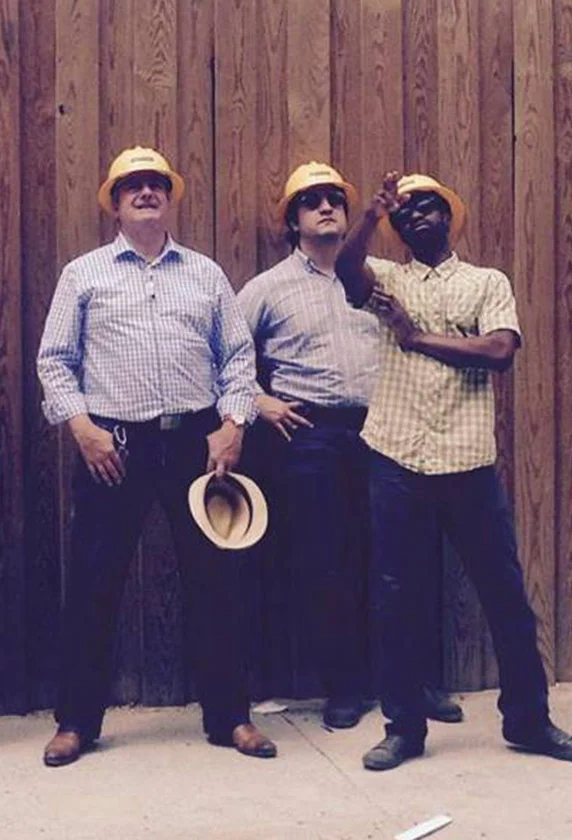
In the same way Dr. Weber directs the complex workings of a hospital, so too does an architect direct the vast complexities associated with designing, constructing and maintaining a building.

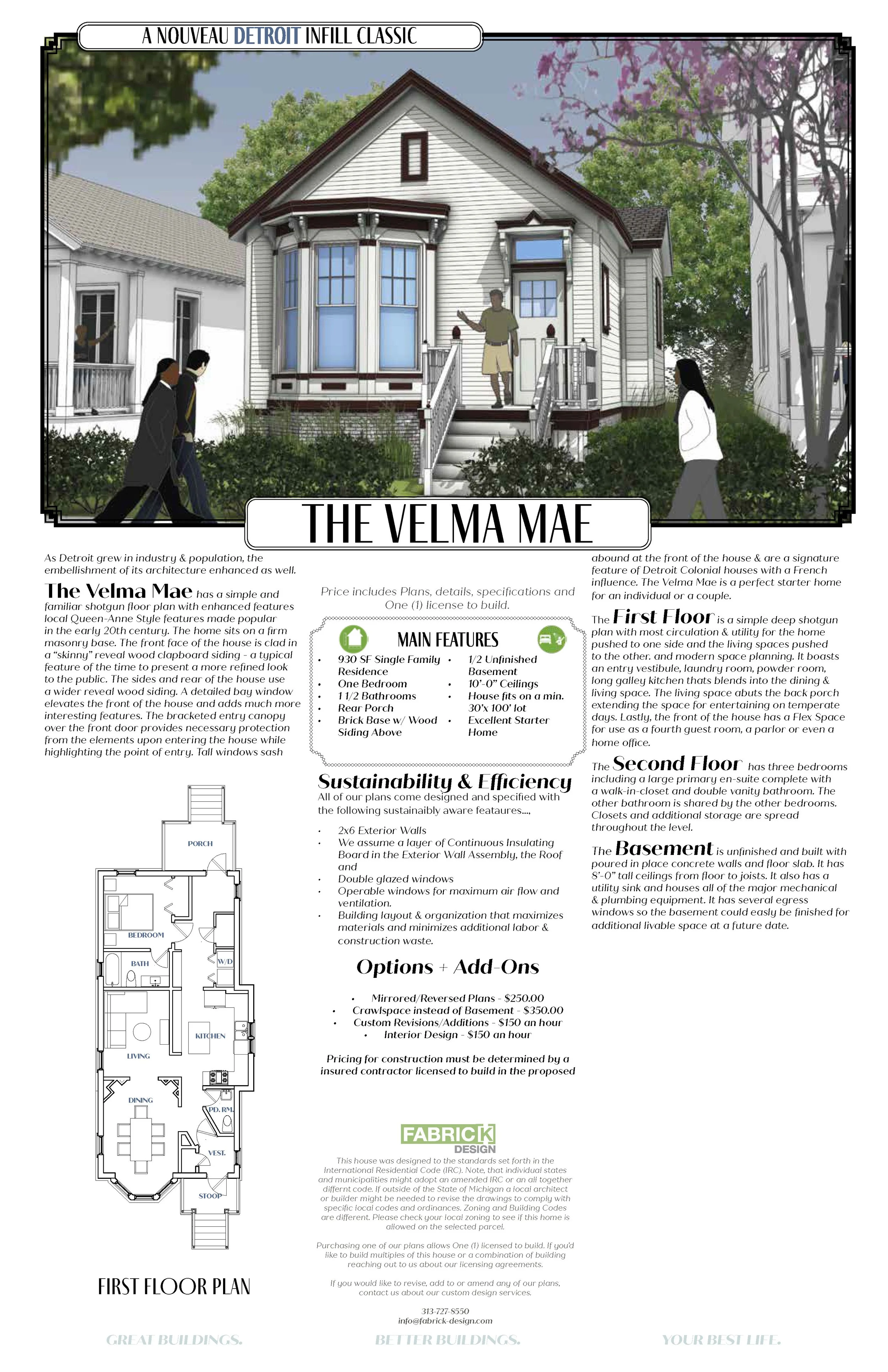
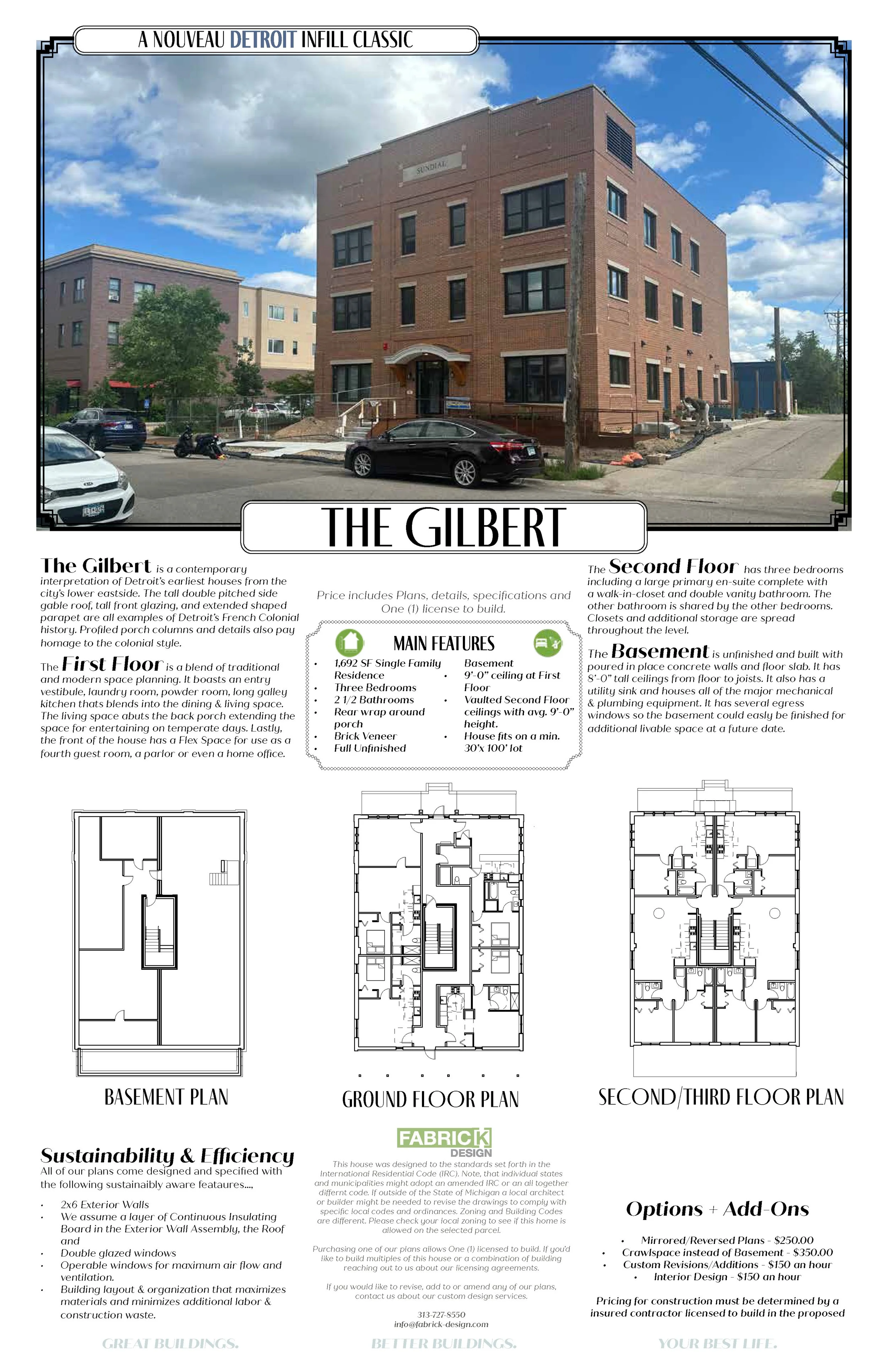

Detroit is the New Rome
Had it not been for these two empires, the world would certainly look different. Rome, over the centuries always managed to realize the value in its ancient, yet, abandoned structures. Now the city is reaping the benefits of history and longevity. Detroit, poised to be America’s version of the “Eternal City”, now sits at a critical pivot point in its history. Will it make decisions in response to economic urgency? Or will it make decisions of historical sustainability that yield innumerable dividends in the long run? I hope the latter, holds true; for there is no town, like Motown.
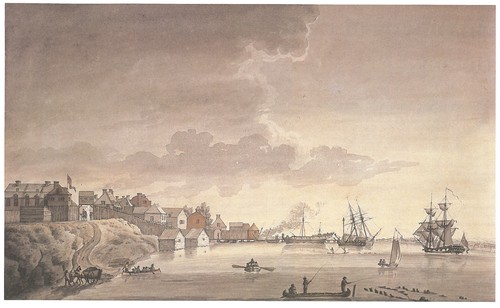

Picture in your mind, a small town nestled near the banks of a river. Now imagine that same town transforming into a great city. And not just any great city, but the greatest of cities; an empire. This city would be home to millions of proud citizens. It would be a global epicenter of technology, manufacturing innovation, creativity and of course wealth. People would flock from all over the world to see this great city, marveling at its prowess and seeking opportunity. As you’d expect, this city would be beautiful. Top notch. Handsomely designed buildings, lush greenery, manicured parks, and imposing monuments that signified civic power. It just so happens that this city would also pioneer various modes of transporting people and goods, and build many roads to connect to far off places. This city would go on to change the course of history forever. Yes, it would be a great city. Not just any great city, but the greatest of cities.
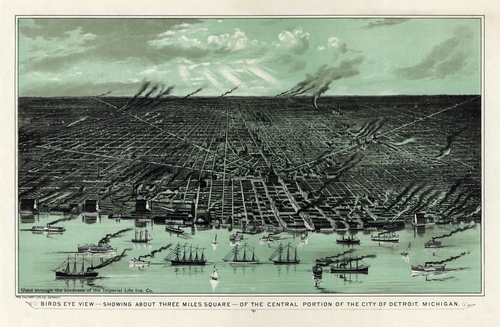

Sadly this city would fall. The millions of people that once lived in this great city would flee for various reasons. Its power would be conquered by forces from faraway lands. This once great city would deteriorate in every way possible. Its wealth would be stripped away. This city would be decimated.
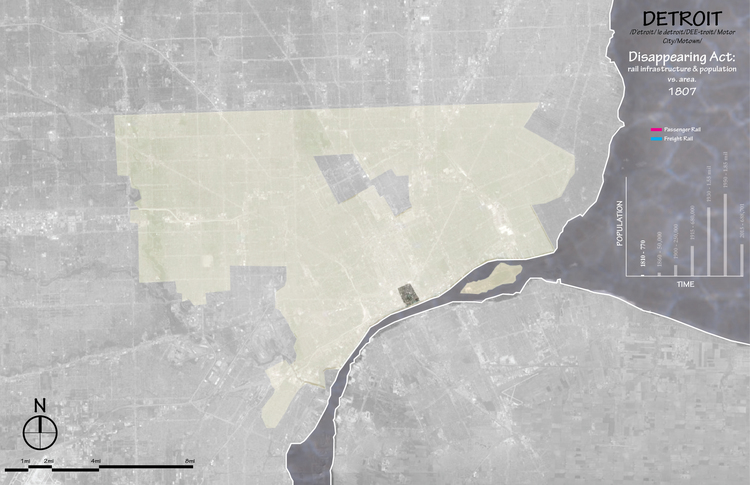
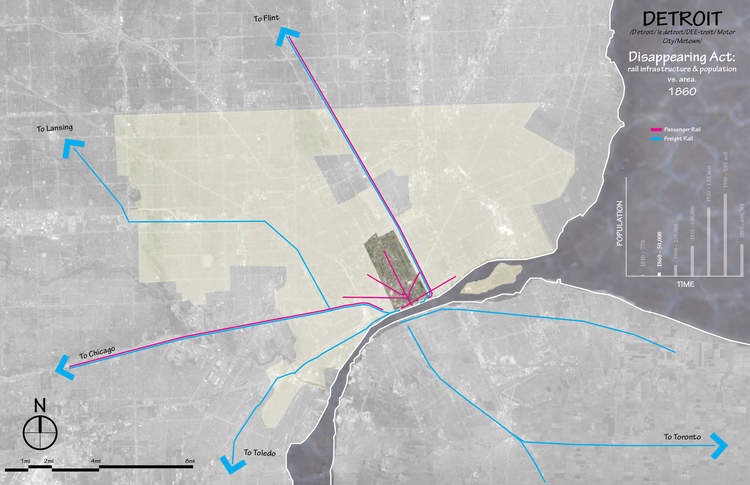
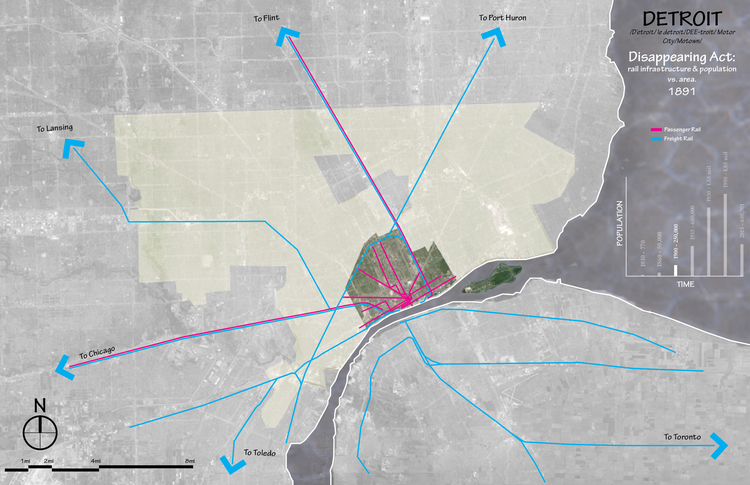
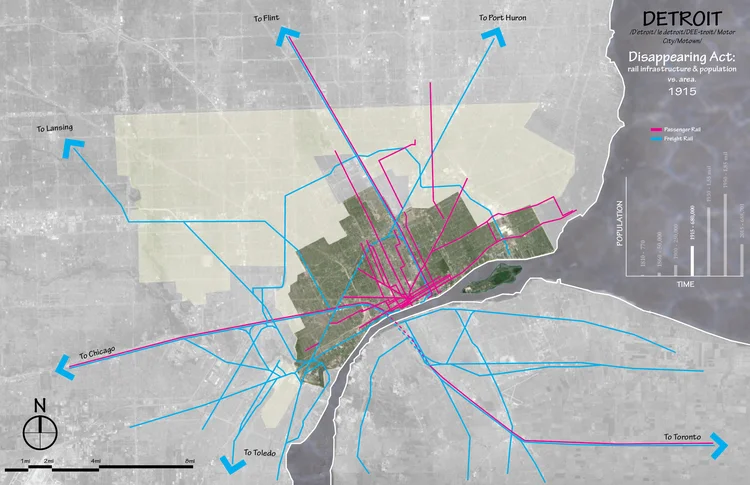


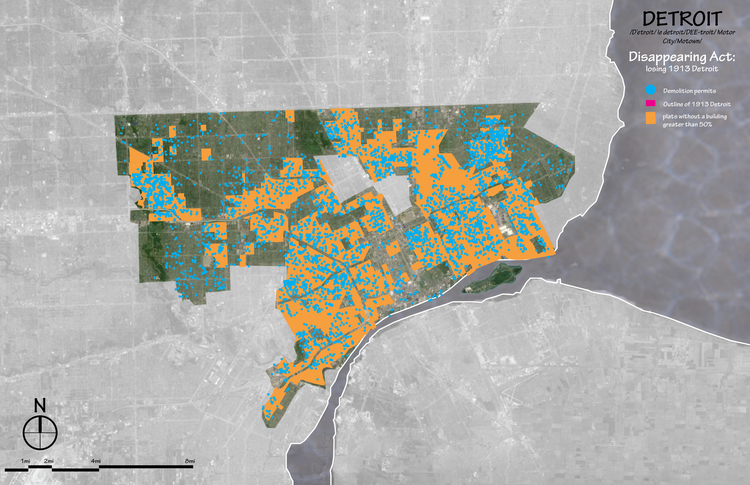
Due to heavy media coverage recently, if I asked you what city I might be talking about, I’m sure 90% of you would say Detroit. Technically, you would not be wrong. But what if I told you a more correct answer would be one of the world’s greatest, beloved, and prestigious cities? It’s a city we now know to be eternal. Excluding cities that have been completely destroyed through efforts of war, the only other city that can match the magnitude of Detroit’s economic, social, and physical demise would be the city of Rome. The narratives of these two places are incredibly similar. Both amassed great power and international acclaim at their prime, and both dwindled into feeble versions of their former glory. The only difference is that Rome has recovered, on numerous occasions.
The Eternal City has endured through time, and all its devices, to become the city of over 3 million that we know today. It attracts millions more from across the globe, and is rich in culture, history, mystery, and timelessness. I believe an integral part to Rome’s longevity and its contemporary prominence has been its ability to retain and adapt its timeless urban fabric through the centuries. These are the structures, systems, and buildings that distinguish Rome from any other place in the world. They help tell its story, one that begins almost three thousand years ago. Detroit could one day become what its ancient predecessor has, rising from the proverbial and literal ashes to achieve world prominence once again. But just like Rome did, it must first realize the irreplaceable value in its unique ruins and monuments; urban structures and systems that are distinctively Detroit.
Governor Augustus B. Woodward was the mastermind behind Downtown Detroit's distinctive radial plan, when he attempted to implement a city grid heavily influenced by Washington, D.C. in 1805. Only one of the radials was actually laid out and it was done so unfinished - Grand Circus Park. Nonetheless, Woodward's plan became a unique part of Detroit's history as the city began to grow. Starting in the 1950's, Detroit's central core (as well as the rest of the city) began to dwindle by way of numerous demolitions, implementation of state and federal highways, and other public works. In my opinion this shows a community with little regard for the irreplaceable value of local and global history and the erroneous infatuation with new, yet, temporary trends. The degradation of Detroit's core is a summary to what has happened to the city as a whole.

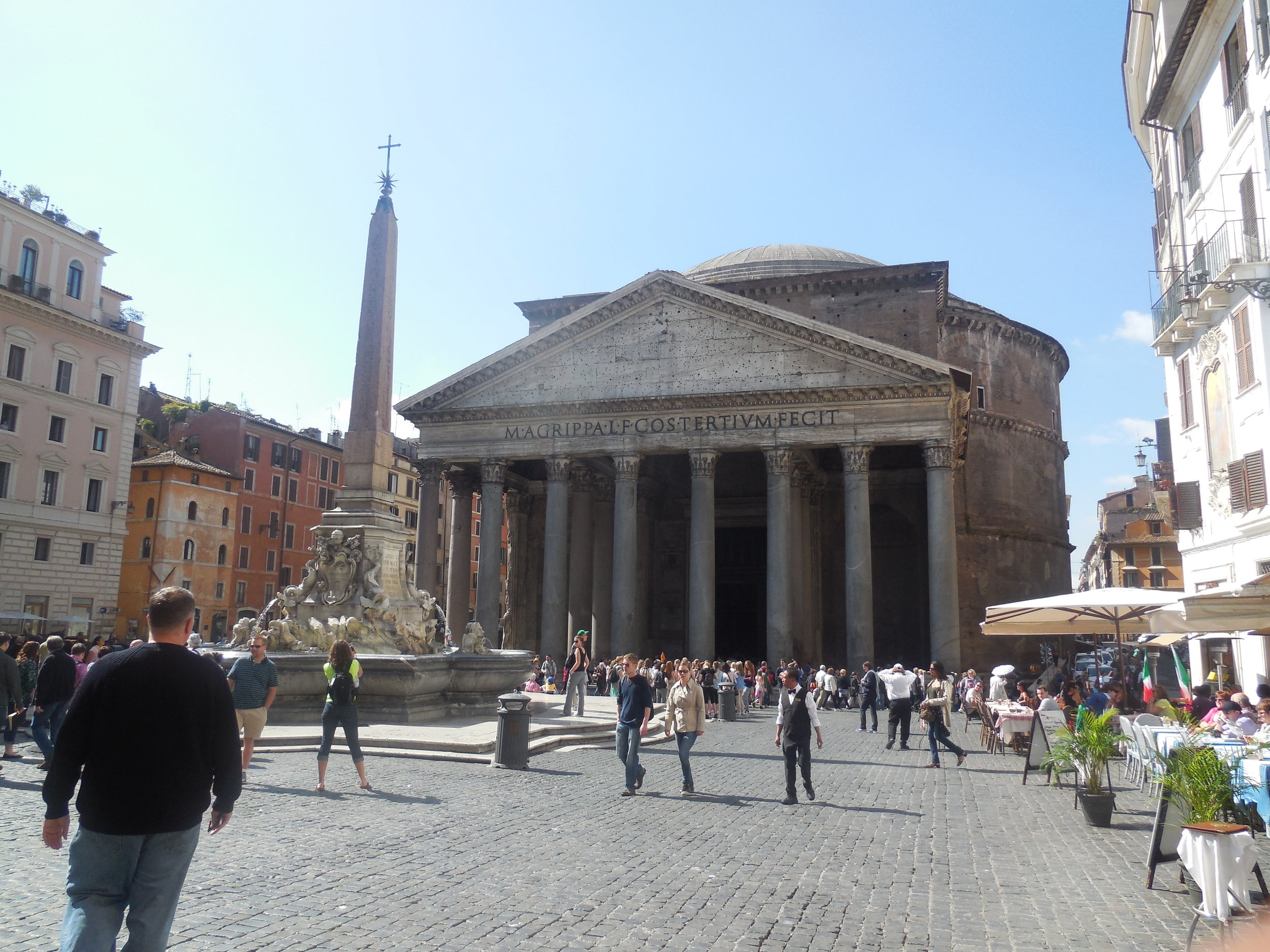
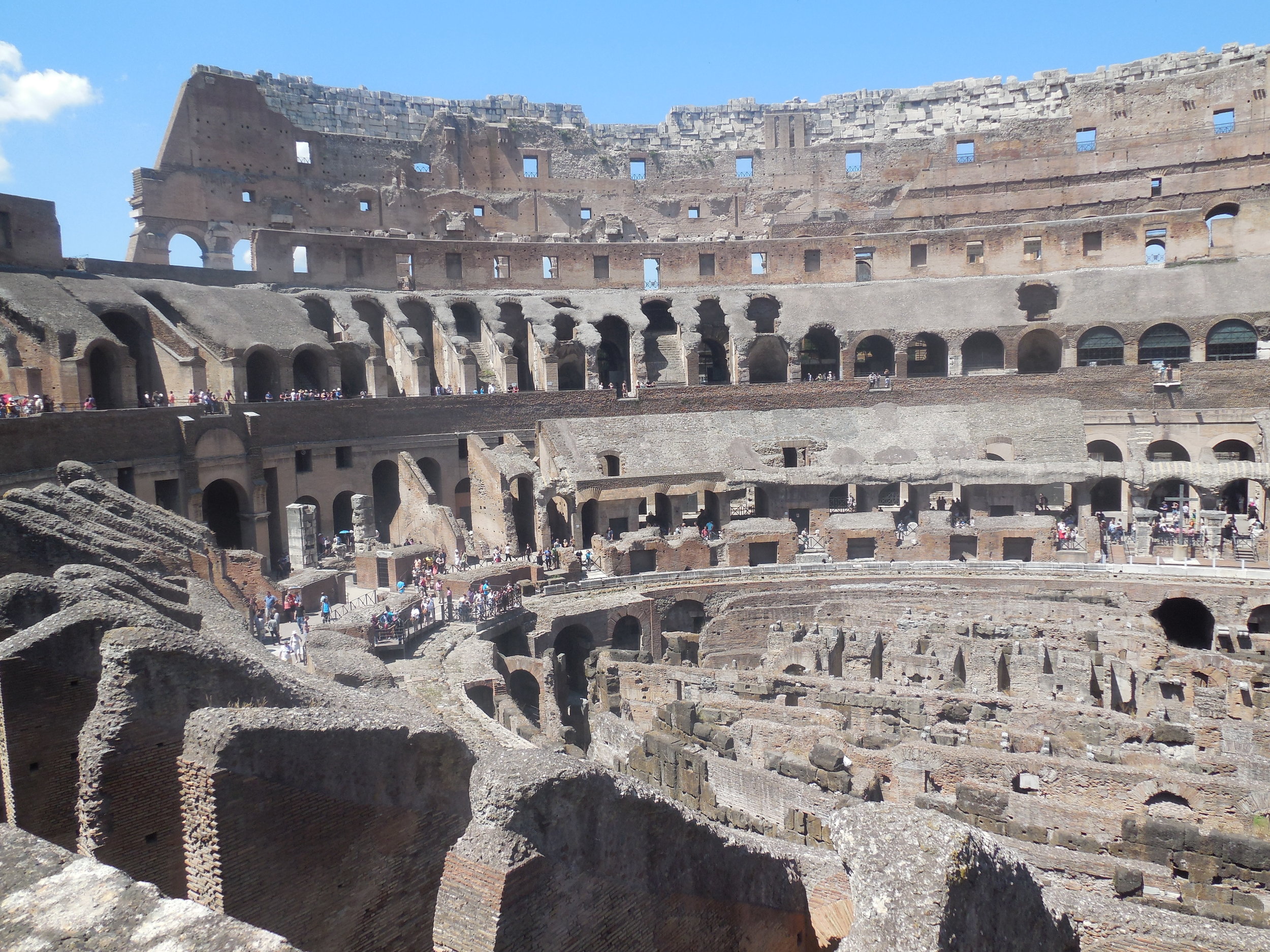
In truth Rome's past is a very complex one. The city has gone through various periods of expansion and contraction over the centuries. It has been ruled by many different peoples and has worshiped under many religions. The one constant however seems to be a reverence for grandeur and history, no matter who or what the social order was. Even when Rome was burned or sacked or pillaged, conquering tribes spared many historical relics such as the Collosuem and the Pantheon. Rome's recent growth and level of stability can be accredited to the unification of various dominions into the Republic of Italy in the mid-19th century. Even in the unification of Italy, this high esteem for Rome's ancient and local history continued. Now, as an ancient city in the modern age, Rome is host to probably thousands of ruins and relics that can not be duplicated in value nor in stature. Some have been made into museums. Some are still in the private possession of the families that built them. Some are public spaces and parks. Some are used today exactly how they've always been used. Function is almost irrelevant. What matters is that a function was found so that these historical urban treasures could still exist today for all to enjoy and learn from.
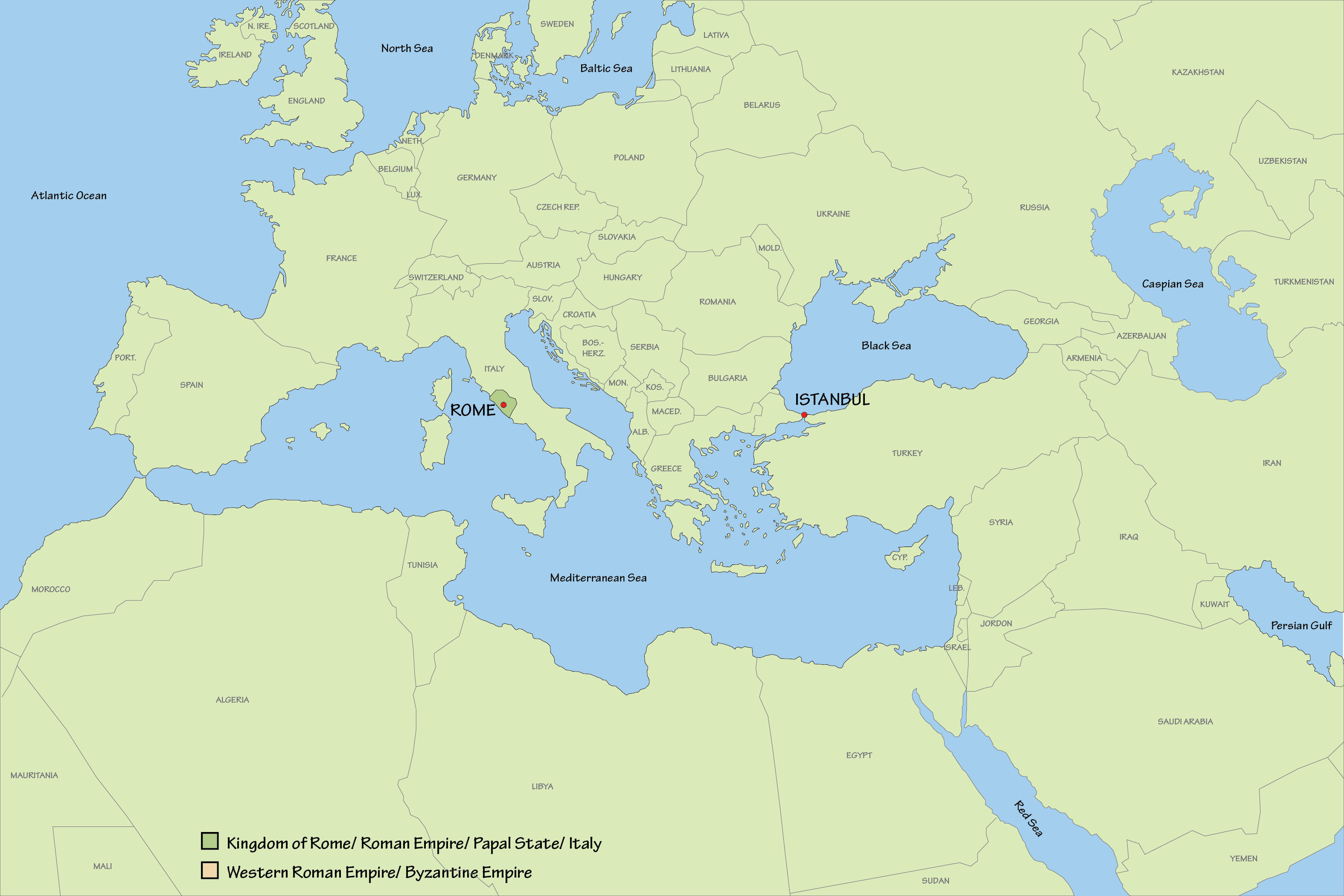
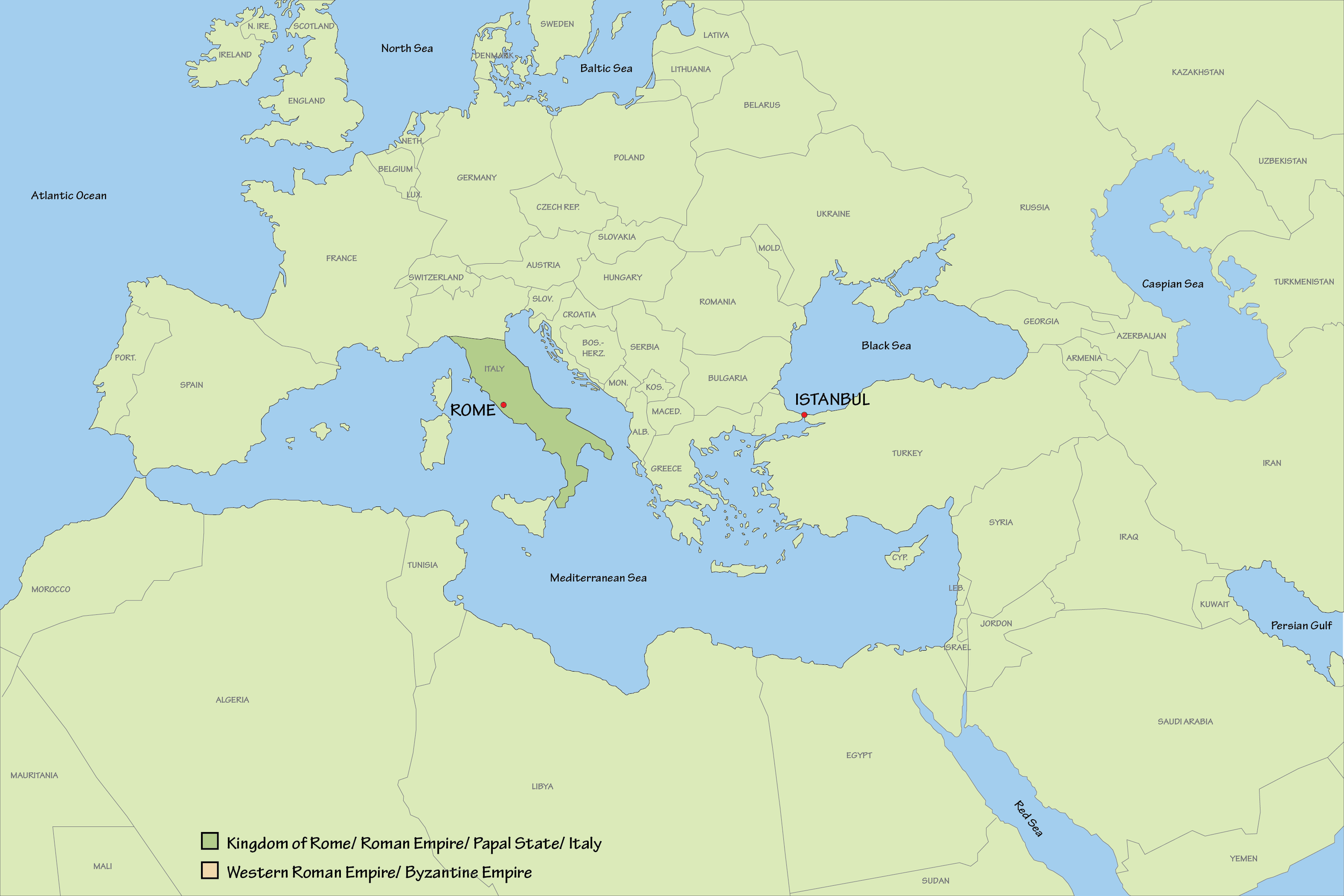
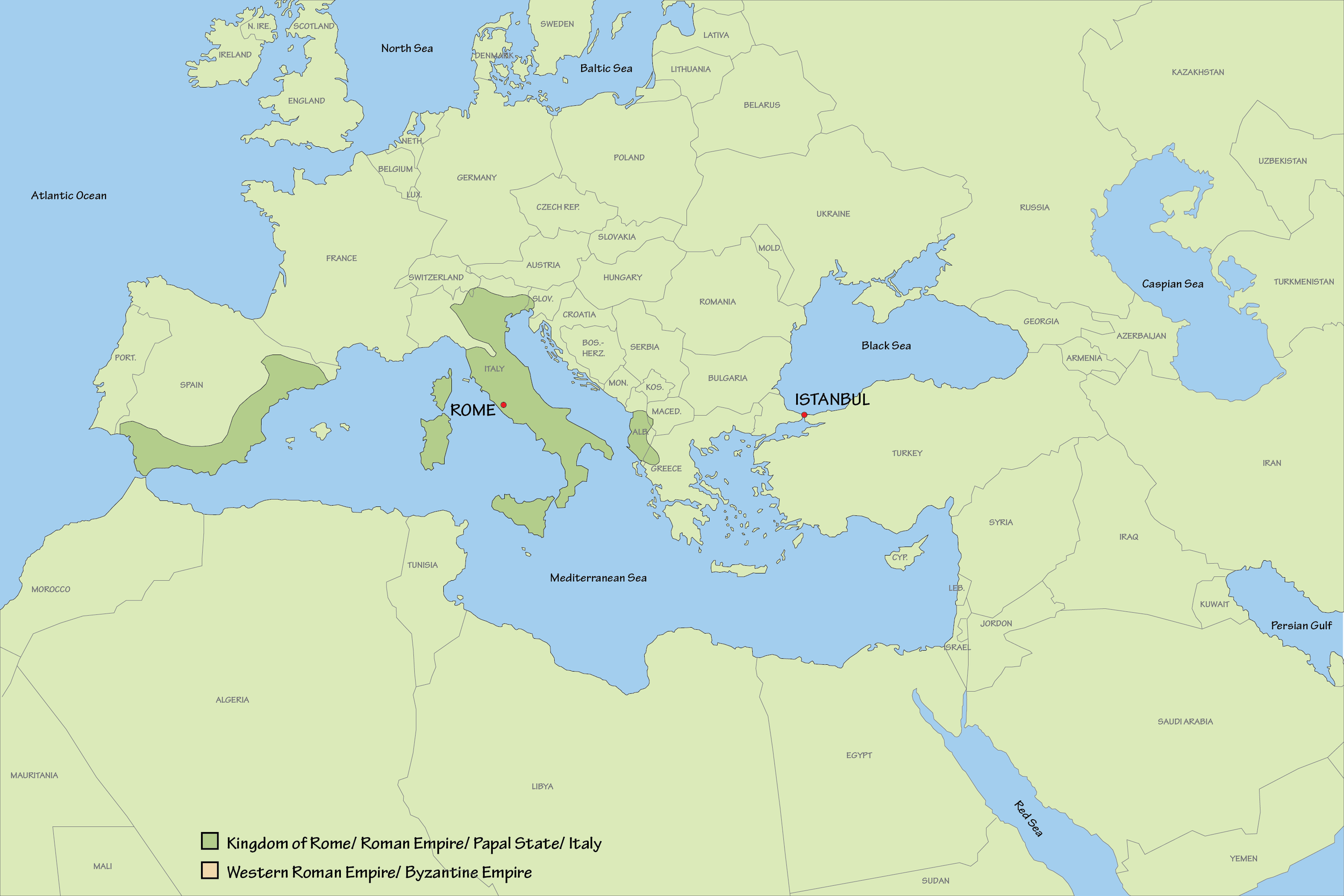
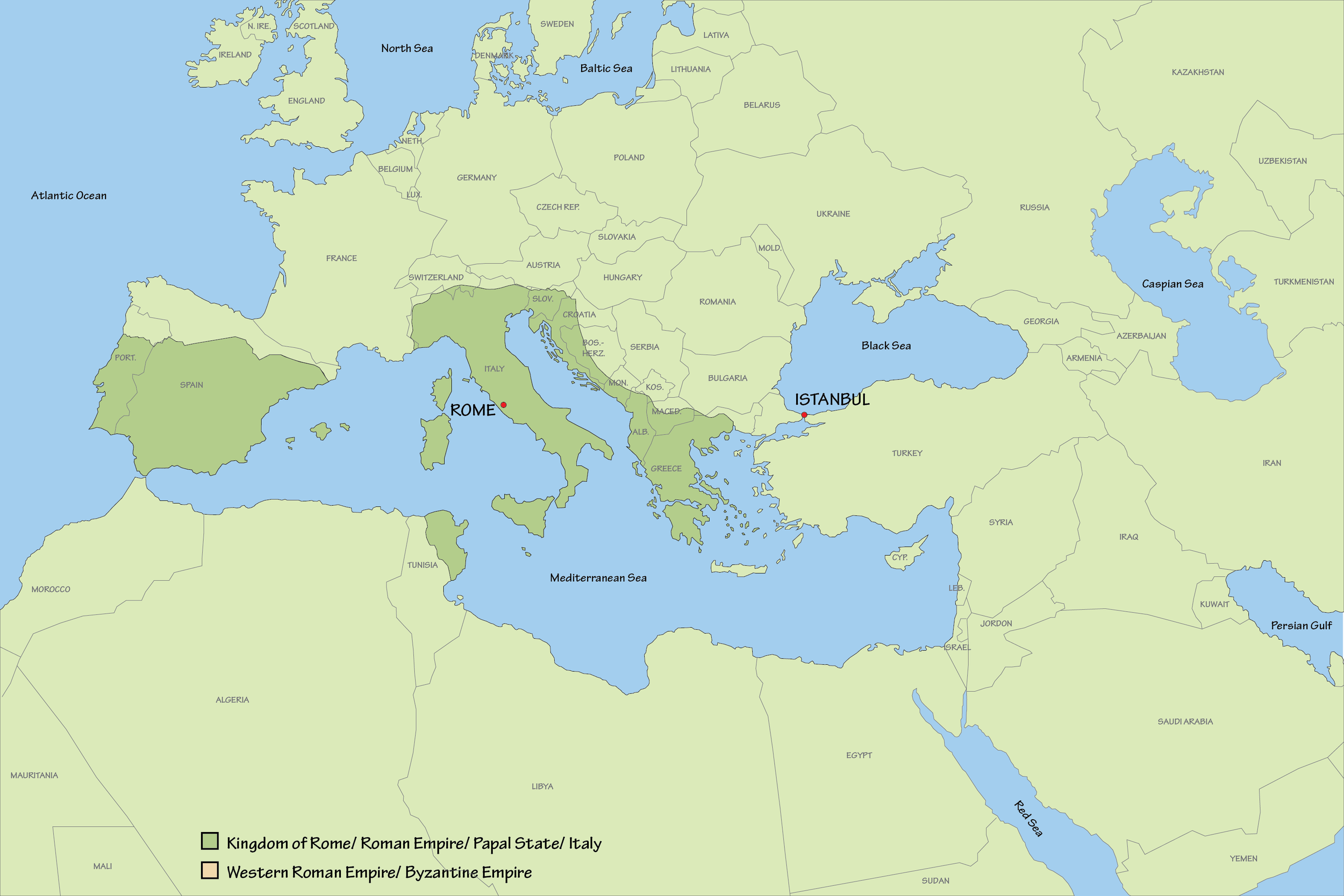


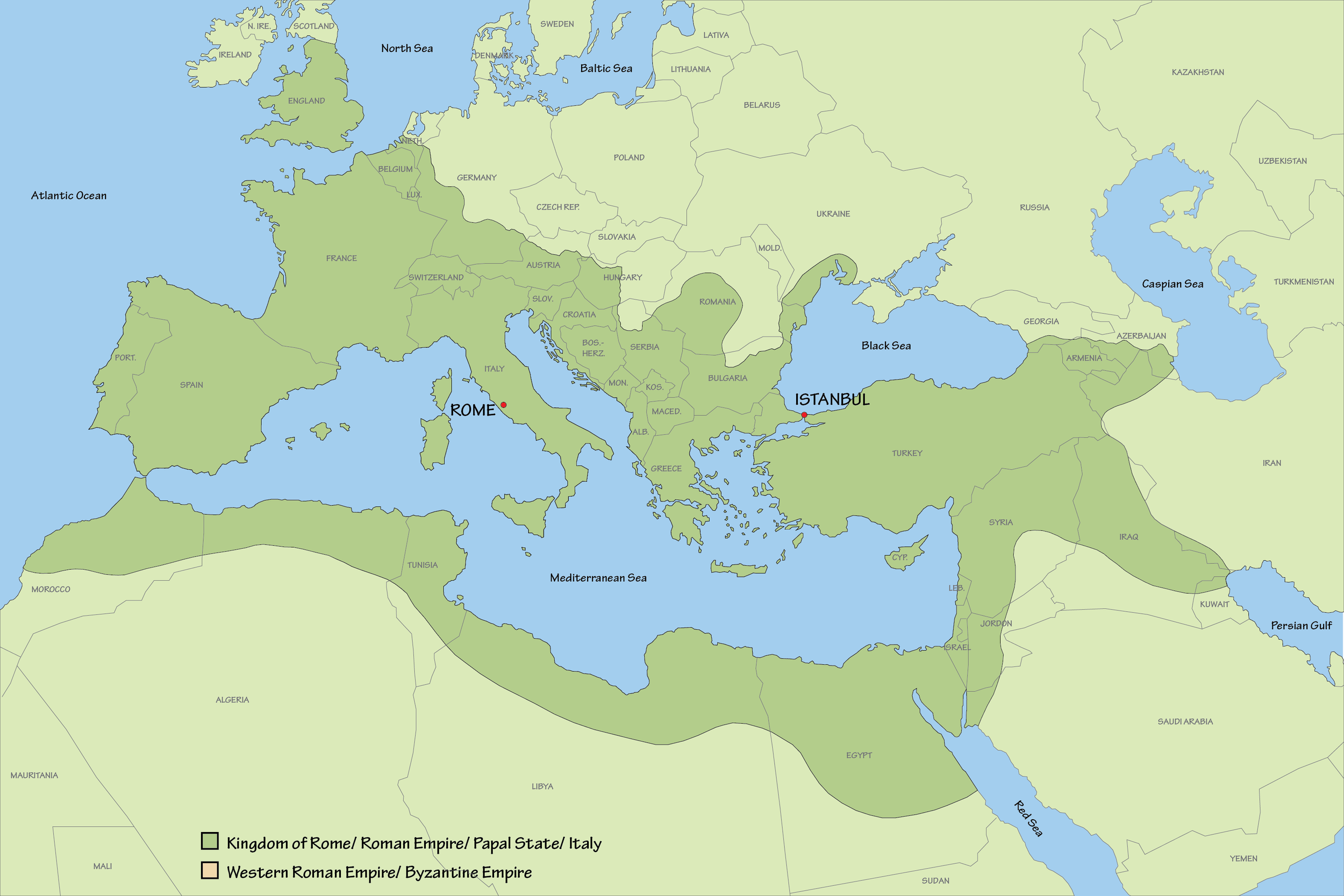
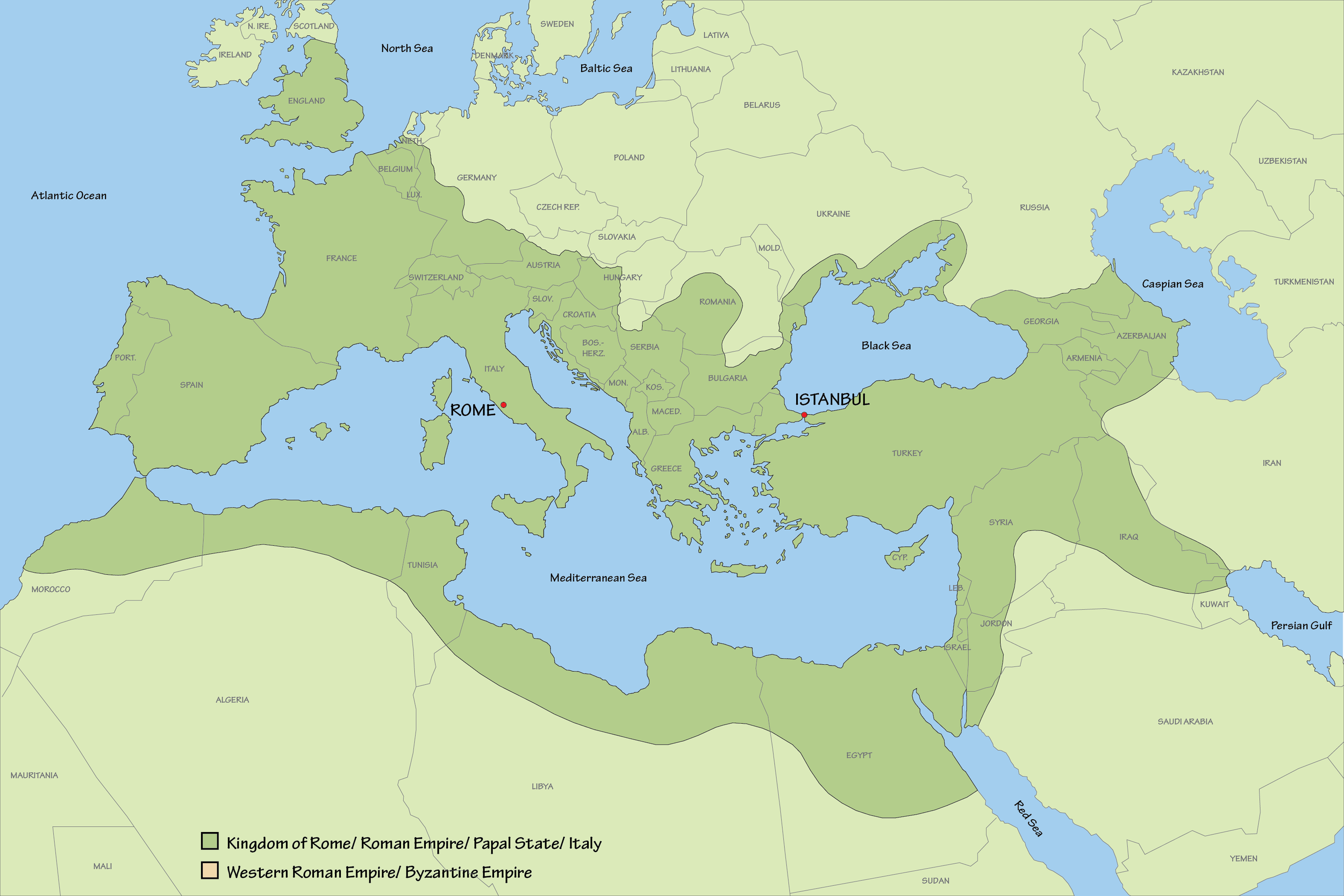

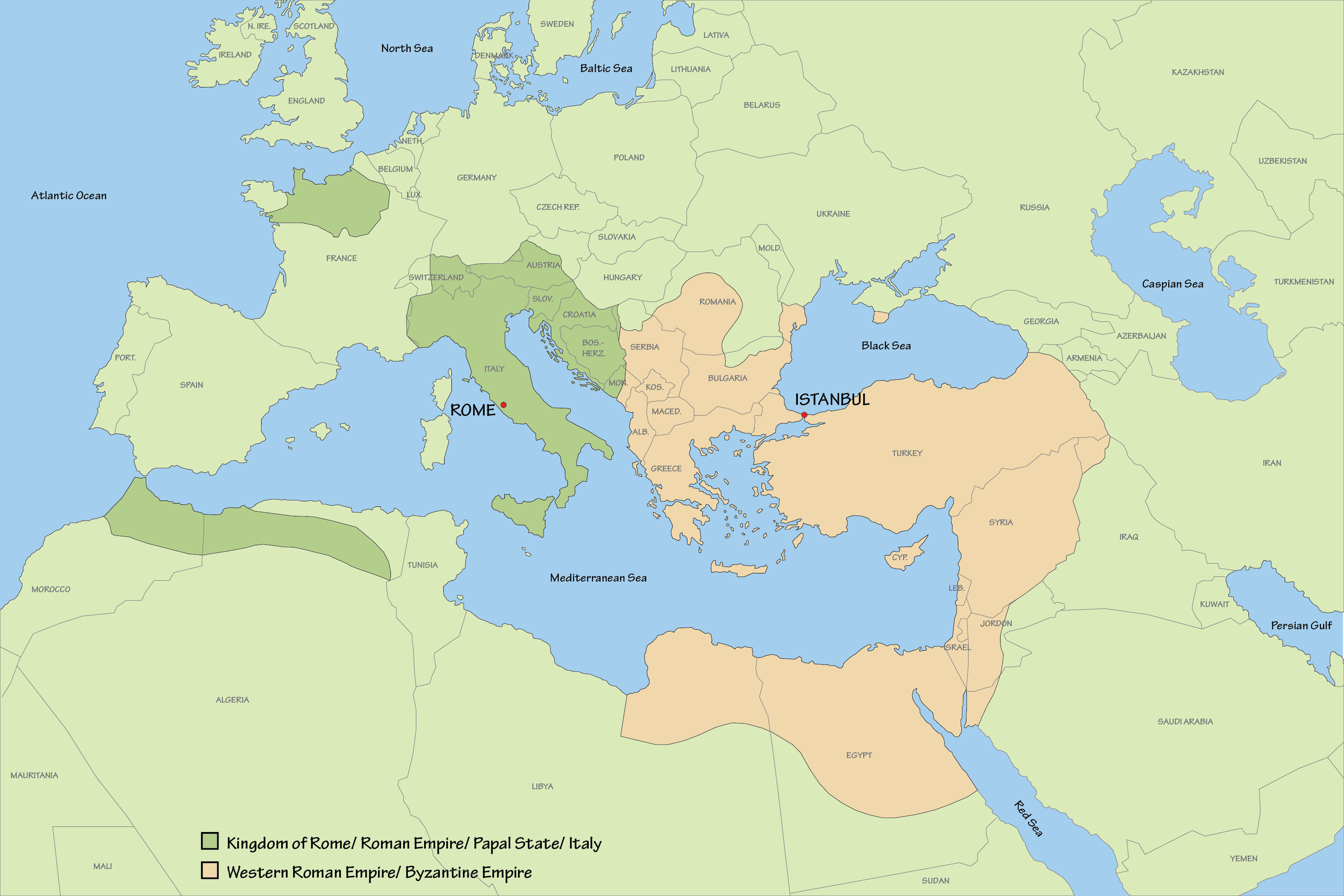


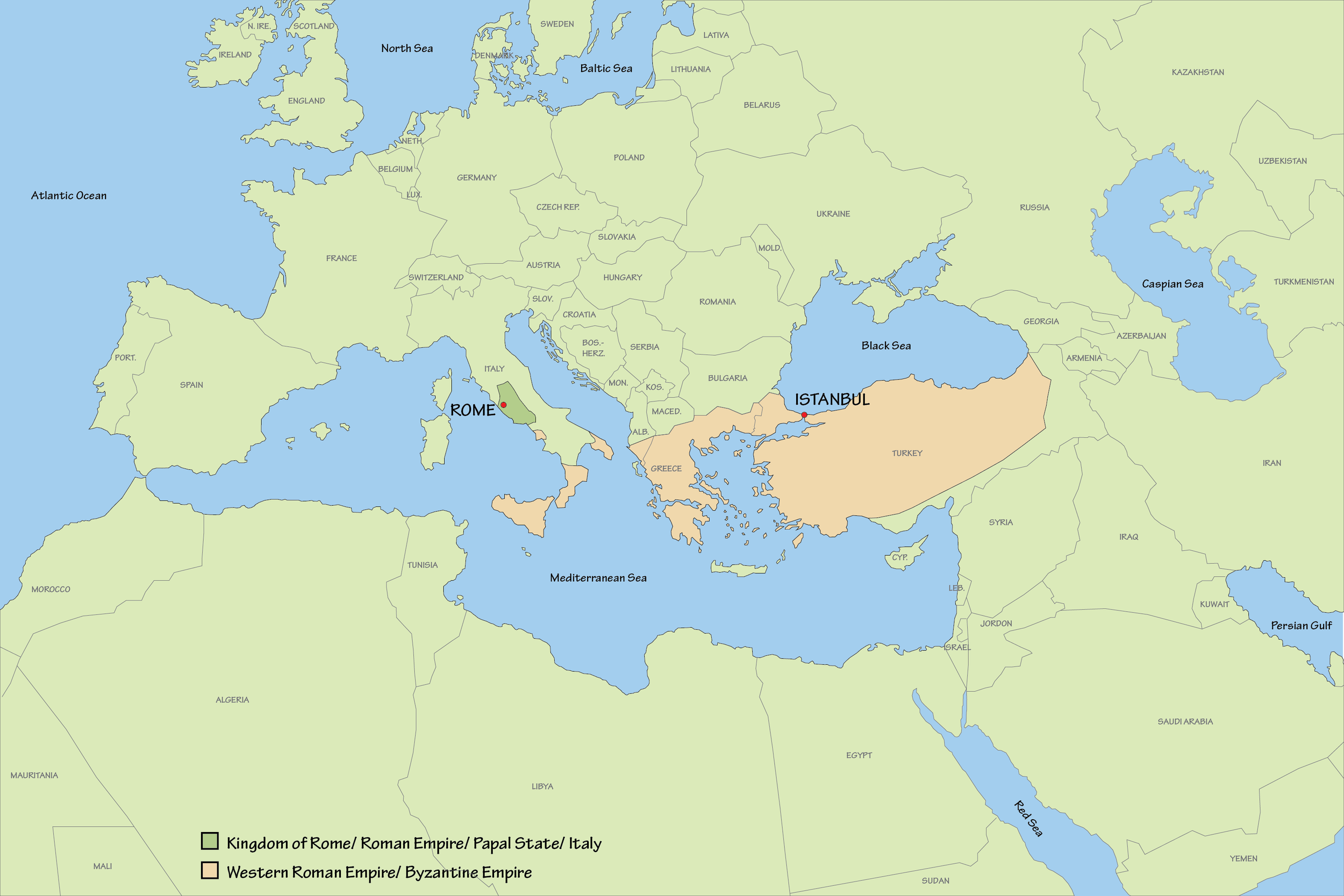
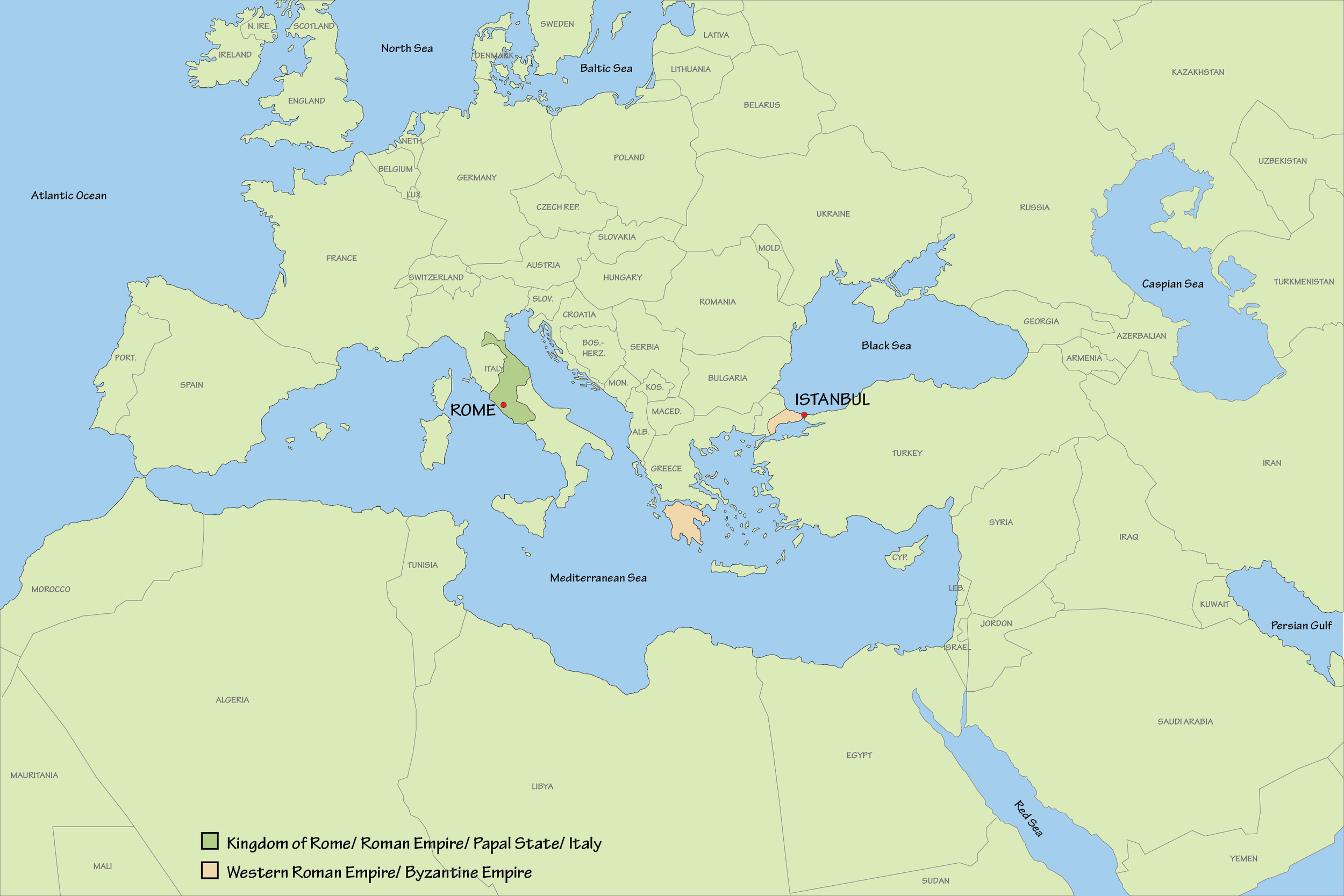


So, could Detroit be the new Rome? Very few American cities, if any, can match the amount as well as the significance of contextually specific and globally important structures that lie in ruin like many European cities can. But Detroit has the potential to do so. However, it can only do so if it realizes the wealth of culturally and globally historic treasures it already has. Treasures that testify to the amazing things that happened here and only here. These urban gems exist in the forms of abandoned train depots, ruined automobile plants, lop-sided mansions, eerie turn-of-the-century skyscrapers, isolated schools, and factories of all sorts. These are the only physical reminders we have left of what Detroit once was. They are imperative to the sustainability of the city’s culture and the perpetuity of its narrative.
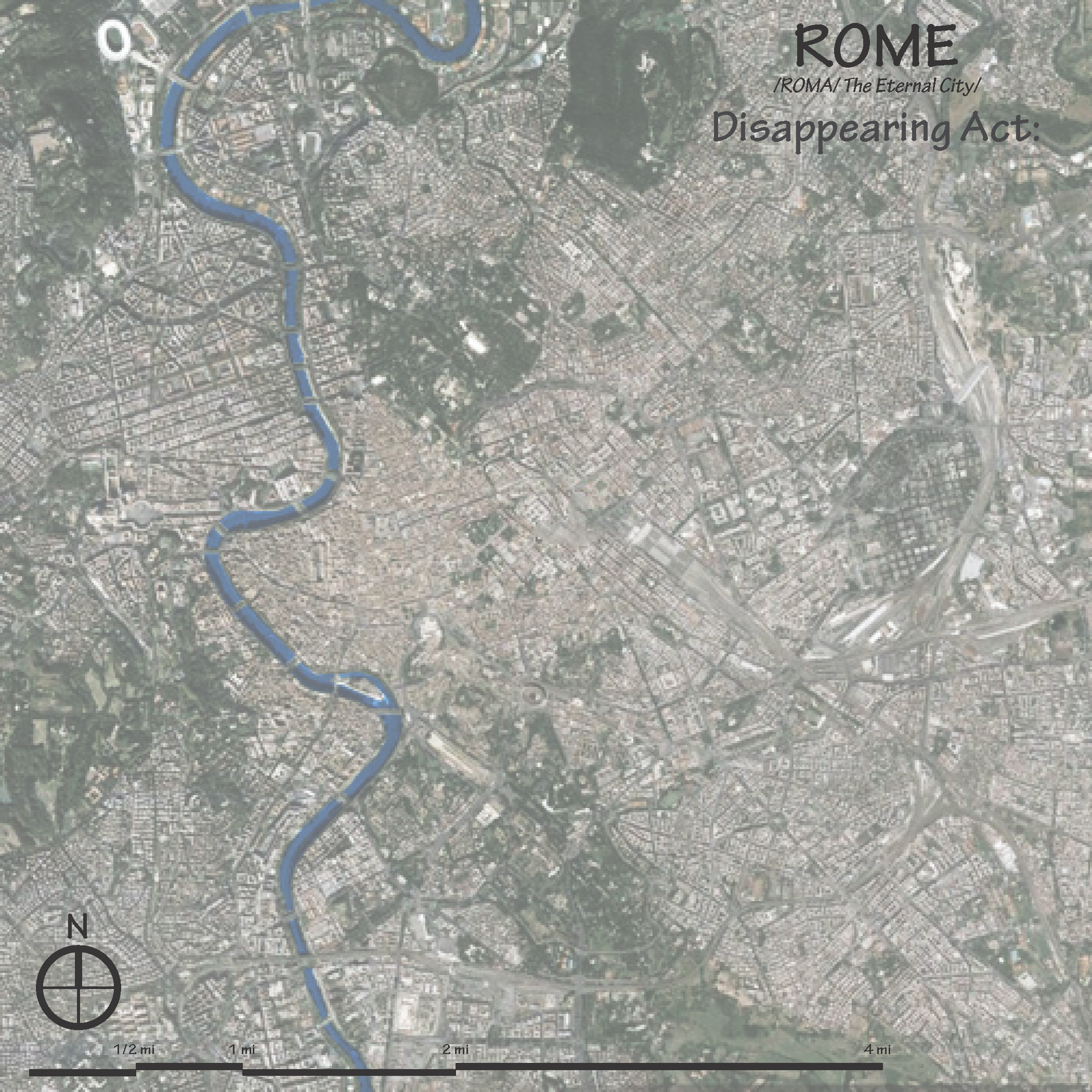


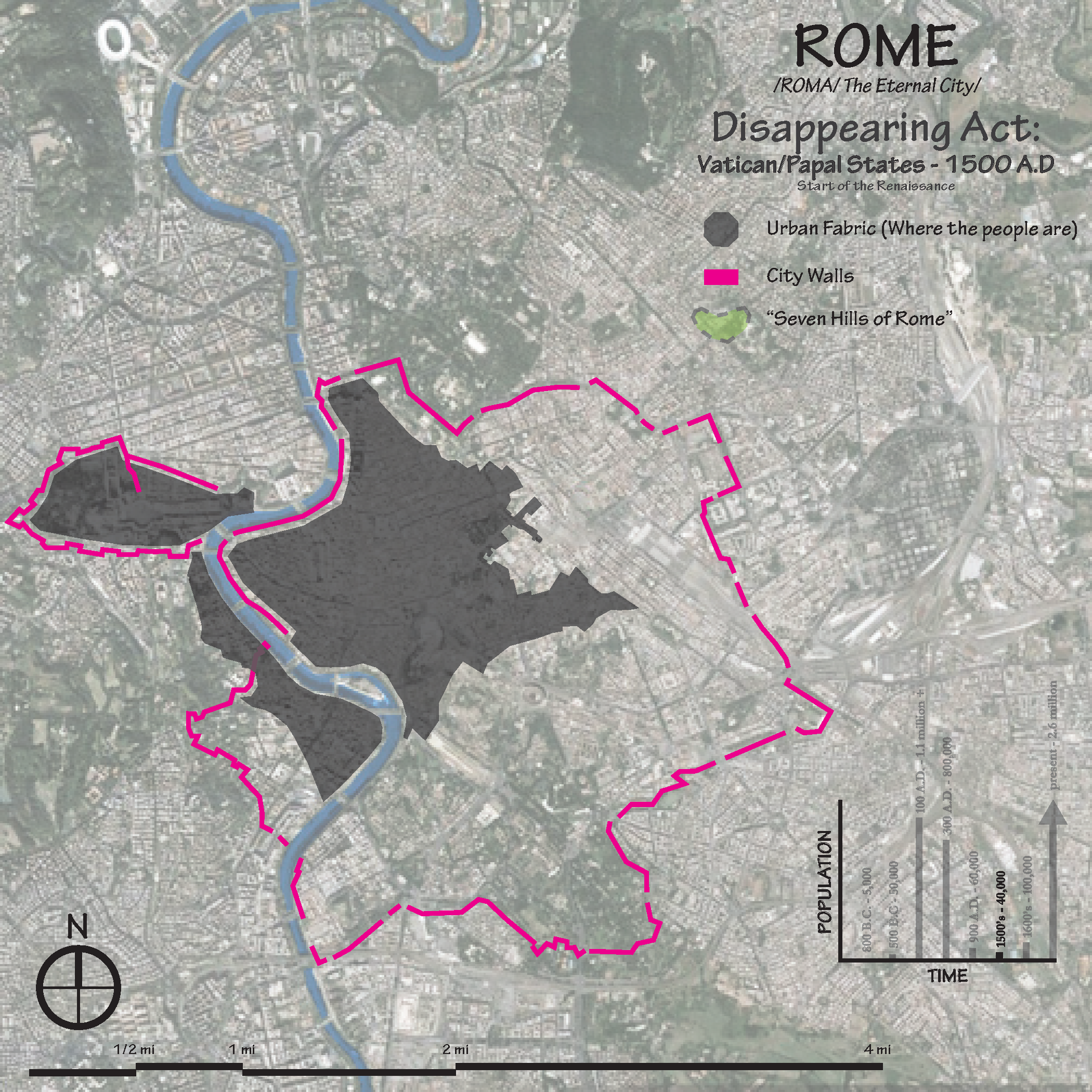
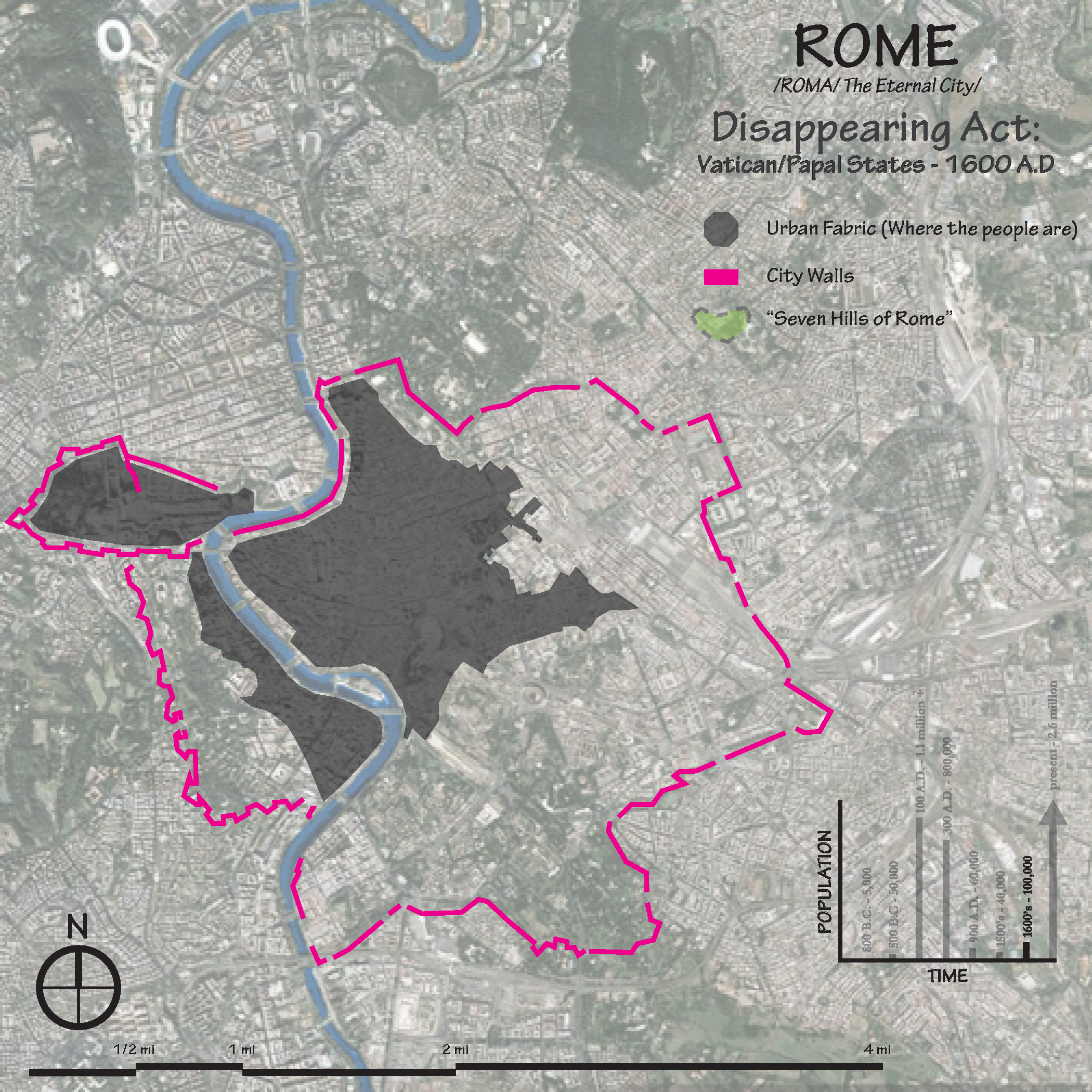
Had it not been for these two empires, the world would certainly look different. Rome, over its many centuries and rulers always managed to realize that there was value in its ancient, yet, abandoned structures. Now the city is reaping the benefits of history and longevity. Detroit, poised to be America’s version of the “Eternal City”, now sits at a critical pivot point in its history. Will it make decisions in response to economic optics, pummeling everything in its path? Or will it incorporate these historically relevant places into its new development to yield innumerable dividends in the long term? I hope the latter holds true; for there is no town, like Motown.
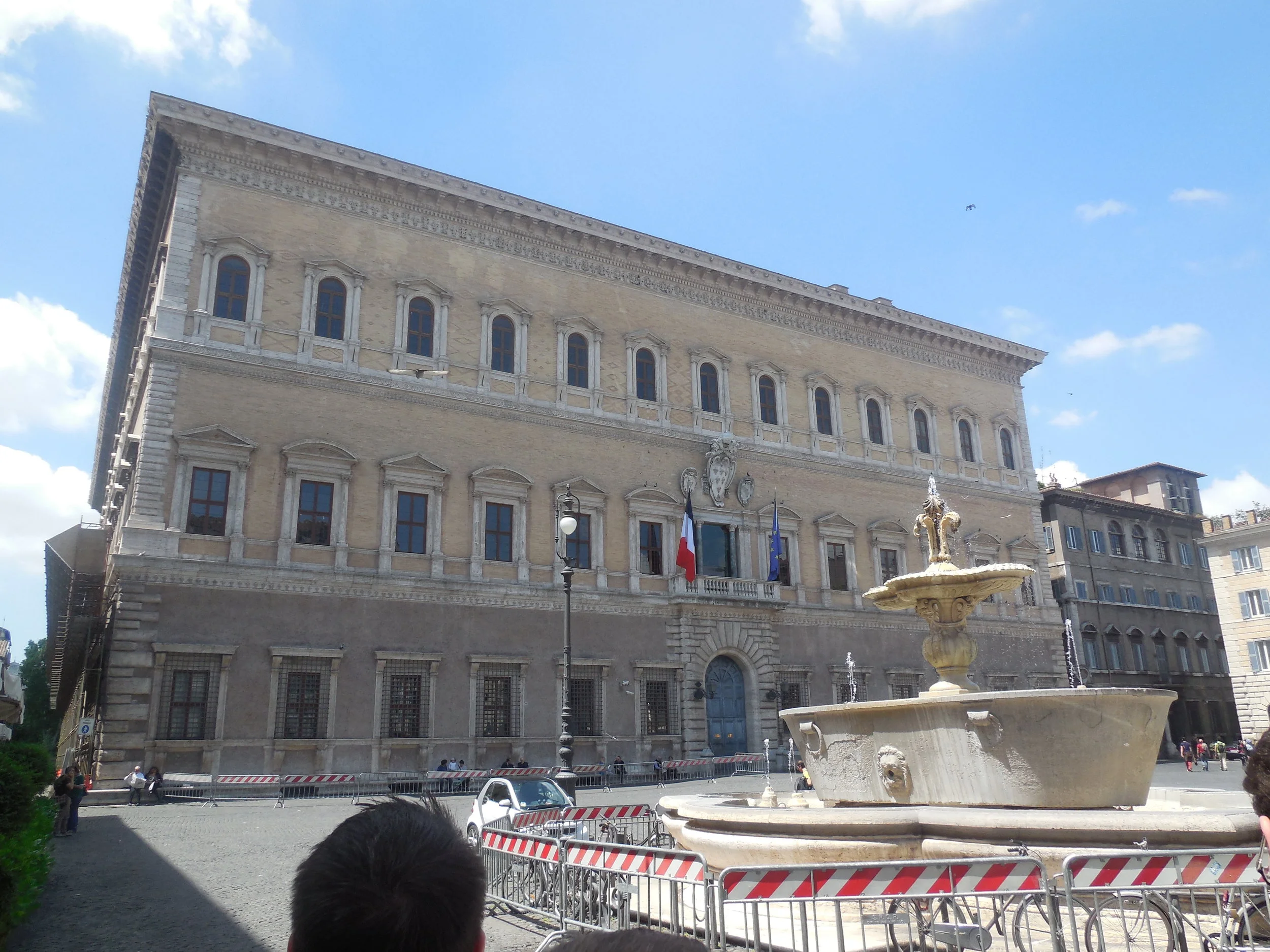
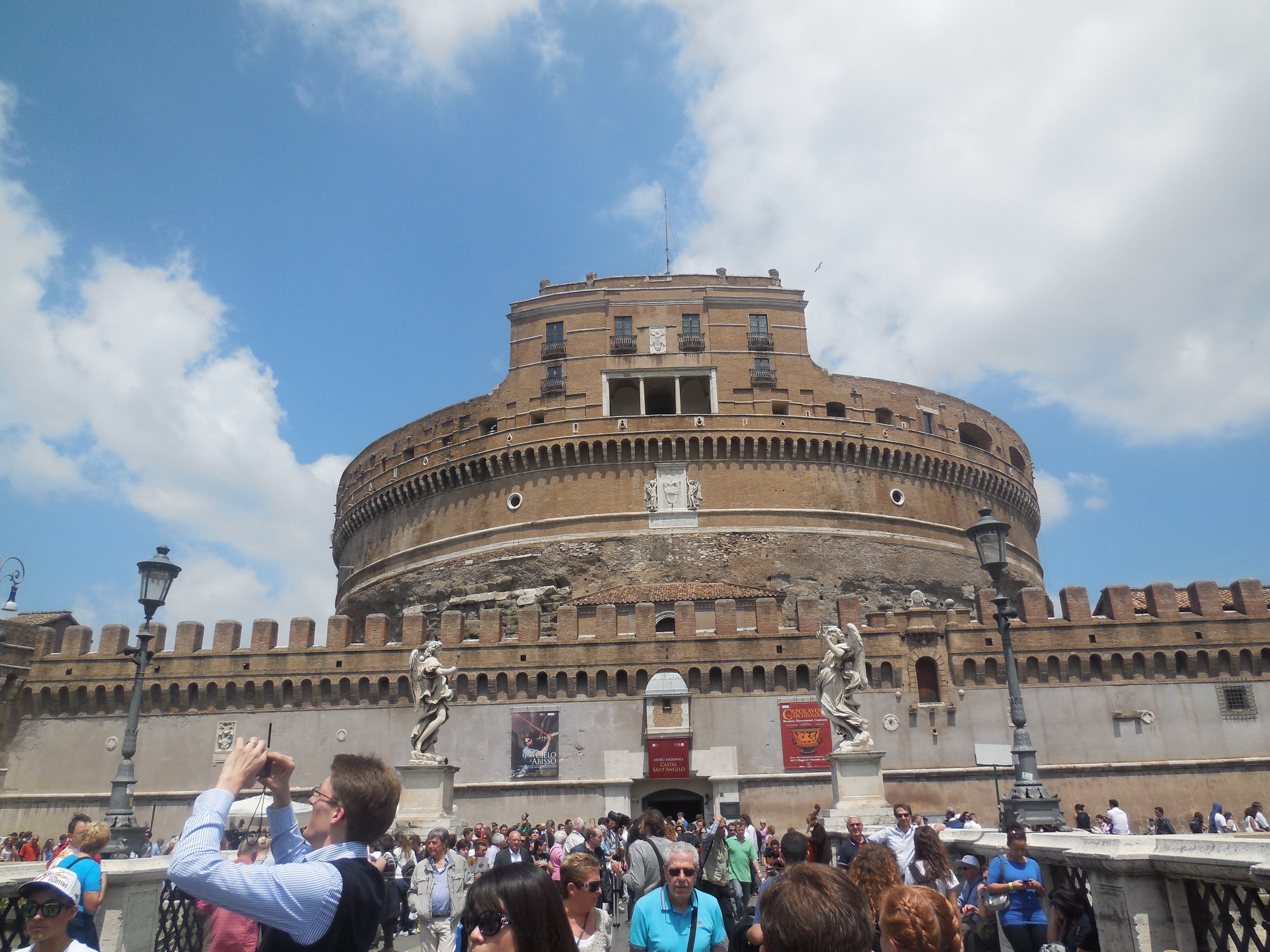
RUINS OF ROME
Ruins of DETROIT





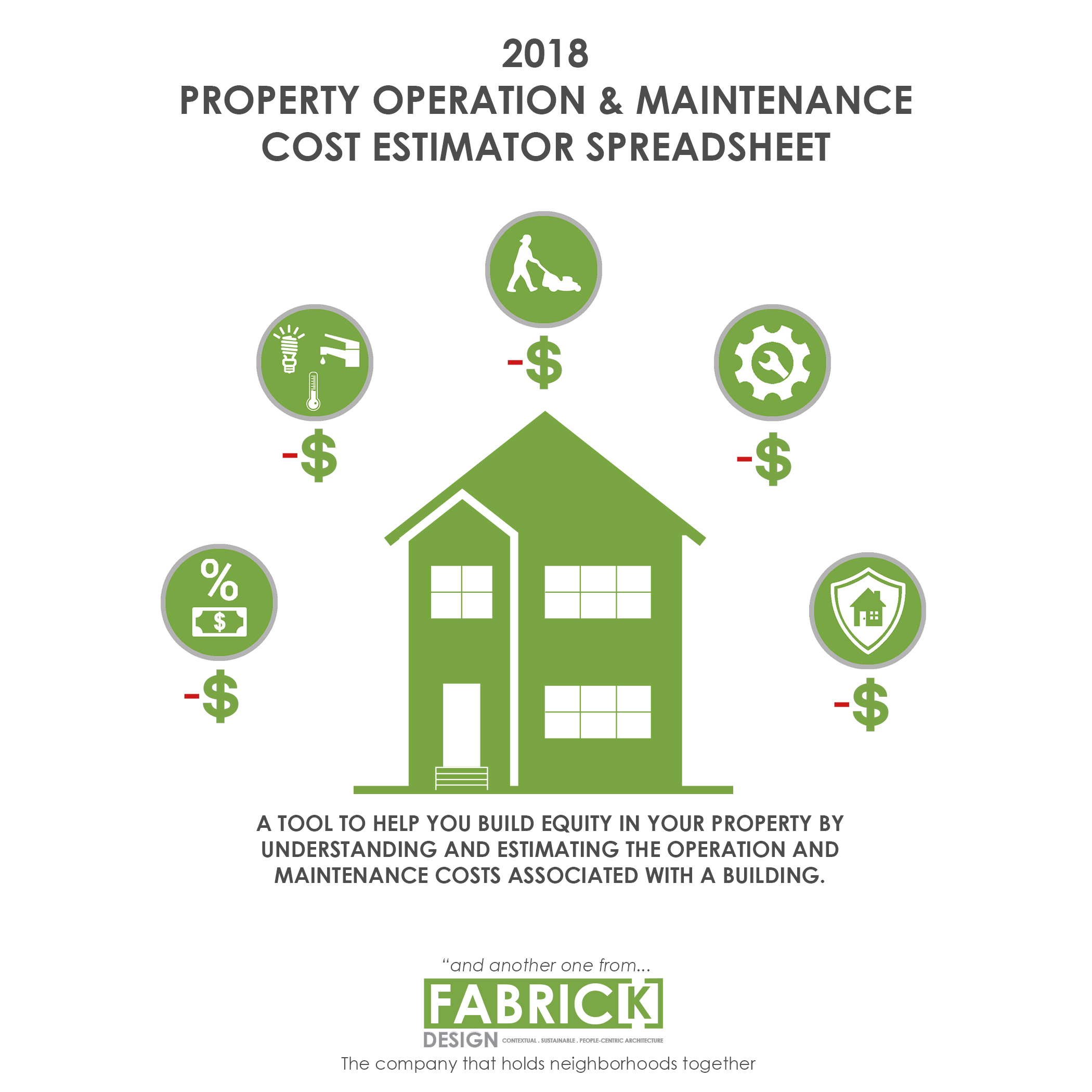
How to Properly Manage Your Property
One of the largest obstacles comtemporary home owners face is how to successfully operate and manage their property. There are many cost factors to be aware of besides your mortgage payment. Determining what these costs are is a crucial component in positioning yourself to budget property expenses properly and potentially build some equity.

One of the largest obstacles comtemporary home owners face is how to successfully operate and manage their property. There are many cost factors to be aware of besides your mortgage payment. Determining what these costs are is a crucial component in positioning yourself to budget property expenses properly and potentially build some equity.
Less than 100 years ago, estate management was more commonplace. For the modern homeowner, this may be a mysterious task. The millennial generation has been significantly slower to own, purchasing property much later than previous generations. There are many reasons for this, chief among them being ownership of extremely high college debt and having to live through a recession. But now confidence in property ownership is back on the rise for the world’s largest and wealthiest generation. In order to see proper returns on that investment coupled with equity growth, it is imperative that new property owners possess the knowledge to properly manage their asset. Here is a list of the principal operating and management cost factors to budget for. This is by no means meant to be comprehensive. Factors will vary from place to place.

- Utilities - Utilities are building services that power and sanitize your property. Typically utilities are billed from a service provider to the property owner, reoccurring monthly. They can be expected to show up every month for the duration of ownership. Common utility services include water, electricity, gas, cable/fiber-optic, telecom, internet, security system, storm sewer fees, and other specialty services.

- Land Management & Maintenance - These are costs associated with the upkeep of property grounds: services like lawn care, snow removal, tree/shrub pruning, landscaping & gardening, and others. These costs are often overlooked. There are those property owners who assume responsibility for these tasks and don’t do them or those that hire a grounds service without keeping track of the monthly cost. Regardless, grounds maintenance should be budgeted for. At the very least a monthly lawn care/snow removal should be assumed.

- Building Repair & Maintenance - Sooner or later something inside your property will need to be repaired or replaced: the boiler, furnace, roof, leaky pipe, broken window, and the list goes on. The question is when? That, we cannot know. Building repair and maintenance is not a monthly recurring cost but it will need to be budgeted for in preparation for the day. Common practice is to put aside a little cash every month. Some stash away the annual equivalent of 1% of the property purchase price ( [purchase price x 1%] ÷ 12 months = monthly repair budget). Others try to save the annual equivalent of whatever $1 per square foot of property amounts to ( [property area x $1] ÷ 12 months = monthly repair budget ). Choosing a number that falls in between these two figures is probably your best guess. And, remember older buildings will require more maintenance. So plan accordingly.

- Property/Homeowner's Insurance - This is insurance specific to home/property owners and is typically paid for in a monthly reoccurring fee. It covers losses and damages to an individual's home or other types of private property. It also covers accidents that happen on the property protecting your investment against things like fire, "Acts of God", break-ins, and bodily injuries. Because there are a lot of insurance products in the market, be sure to shop around for the best value.

- Property Taxes - This is a percentage tax levied on the value of the property and is a major source of income for the governing bodies that collect them helping to pay for services like transportation, trash removal, education, parks, and more. In the U.S. property taxes are calculated by a millage rate determined every year by the various governing bodies. That mill rate is multiplied by the taxable value of the assessed value of your house or property. The basic equation goes like this… Annual taxes due = [ mil rate x ( taxable value = assessed value x assessment rate)]. Tax breaks should they apply are usually included in the assessed rate as a lowered percentage. In Detroit for 2016, the total millage rate was 70.09 mills or 7.09%. Millage rates vary widely across the U.S.
- HOA Fees (Homeowner's Association Fees) - These are costs uniquely associated with condominiums or planned communities of condos. The fee is assessed based on property size and rates can vary widely, depending on the by laws of the HOA organization.
Add these costs to your monthly mortgage payments to get the operating and maintenance cost of your property. Rates typical change every year, so you will have to adjust this number annually. Operating costs are a critical component in determining the true equity you have gained or lost in a project. EQUITY = Assets ( Mortgage Payments +/- land/property value) - Liabilities (Capital Costs + Operation Costs + Maintenance Costs).
Related products at the [K]ORNER STORE

How to Choose What Neighborhood to Buy In
Among the neighborhoods you will evaluate in the search for property key characteristics of value will vary in quality. In some cases they may be slightly intact while in others they may be completely absent. Places like Detroit are unique because many neighborhoods lack a lot of these valuable assets. But these are precisely the neighborhoods that should be looked at more closely. By finding what’s missing in a community, you will have uncovered an opportunity to bring tremendous value somewhere it’s needed.
Re-Introducting the Neighborhood
Where to buy or invest? With the goal of building positive equity, this is another primary concern for future property owners, alongside operating costs of the property. To address this we need to take it back in the day a bit. One of the oldest and most effective indicators of a vibrant neighborhood is its ability to provide all the basic daily needs its residents will require within a 1/2 mile metric - the equivalent of a 10 (ten) minute walk. For thousands of years, humanity has used the ½ mile metric to create some the most valuable, efficient, and sustainable communities on Earth. Using this metric we can quickly analyze the value or potential value of a neighborhood based on three primary factors: Land Use Diversity, Transportation Options, and Close Proximity.
The first question you should settle before buying property, is “what is your level of commitment”? How long you are planning to own the property will determine the answer to this question. For the purposes of this conversation, we will focus on long-term ownership and equity building.
Diversity of Land Uses
Once you determine whether or not you’re in it for the long run, the next thing you want to look for is a diversity of uses - a collection of commercial goods & services, entertainment venues, civic resources, recreational amenities - immediately available to neighborhood residents. This signifies a healthy flow of cash within the neighborhood and also a self-sustaining community of people, commerce, and institutions at the local level. When critiquing a neighborhood ask yourself: Where is the grocery store?; Where’s the bodega?; Where are the schools?; Where’s the pharmacy?; Is there a barber shop? Where’s the restaurants? Where are the parks? Where’s the Library? Where’s the $2 coffee shop? Every neighborhood is different, but the formula stays consistent. A healthy mix of different and desirable land uses helps to raise the value of land around it - your property included.


Transit options
You also want to look at the neighborhood’s access to different forms of transportation. Access = Value. It may not seem like it but the simple ability to move from place to place is a very powerful action and will always be extremely valuable. Driving it seems will always be a viable transit option in contemporary society. However, it will play a more minor role in moving people as cities shift back to more sustainable modes of transportation like walking, biking, reliable buses, and light & heavy rail. When surveying your neighborhood look for transit options. Find the bus stops and where their routes connect to. Figure out where the bike lanes are and where they go. Take notice of the quality and character of the streets and sidewalks. If your city has one, look at the rail options and the ease to which you can access them. The more transit options your neighborhood has, the more likely it will have a positive effect on land values in the target area.


Close Proximity
This last point is a combination of the previous. If Access = Value, then Easy Access = Priceless. Think about how most Americans live their lives. According to the U.S. Department of Transportation on average each of us spend nearly two hours each day driving doing things like going to the grocery store, or work, or school, or to shop. In the process we waste precious time we can’t get back as well as hard earned money. Now imagine all it took was a 10-minute walk to get to the grocery store, instead of the usual 3o something minute drive. Apply that imagination to all your typical daily tasks, and I'd bet you'll discover a tremendous amount of time savings. Now, that recaptured time can be spent doing more of the things you enjoy with the people you enjoy the most. And that’s true value. When you have everything you need on the daily, inside your immediate surroundings, you are able to live a better and healthier lifestyle and you will certainly see this reflected in the value of land.


Create The Neighborhood You Want To Live In
Among the neighborhoods you will evaluate in the search for property, these three characteristics of value will vary in quality. In some cases they may be slightly intact while in others they may be completely absent. Places like Detroit are unique because many neighborhoods lack a lot of these valuable assets. But these are precisely the neighborhoods that should be looked at more closely. By finding what’s missing in a community, you will have uncovered an opportunity to bring tremendous value somewhere it’s needed. Within reason and comfort, find the missing links in a neighborhood and fill that gap. Build your home on that empty lot. Buy that two family flat, fix it up and rent it out. Bring the $2 dollar coffee shop to the empty retail building on the corner. Start the weekend Farmer’s Market that brings fresh quality produce to your community. Plant trees along the street to make it more enjoyable for walking. As these ‘gaps’ begin to fill in, the value of the neighborhood will commence to increase and you will better position yourself to see great returns on your financial and 'sweat' equity investments.

Detroit's "comeback" will not be solidified until its neighborhoods make a comeback as well. Who better to begin revitalizing these neighborhoods than the citizens themselves. Instead of waiting for some financial "savior" developer to bring salvation to a neighborhood, you be the change the neighborhood needs to see. If you don't, someone else will.
Set up roots in your neighborhood and make it what you want it to be - A place of value. And what’s more valuable than living in a place you helped build? Don’t wait for some magic developer to come and save your neighborhood. They’re not coming. You be that change. You be the neighborhood.
Real Estate, The Best Long Term Investment
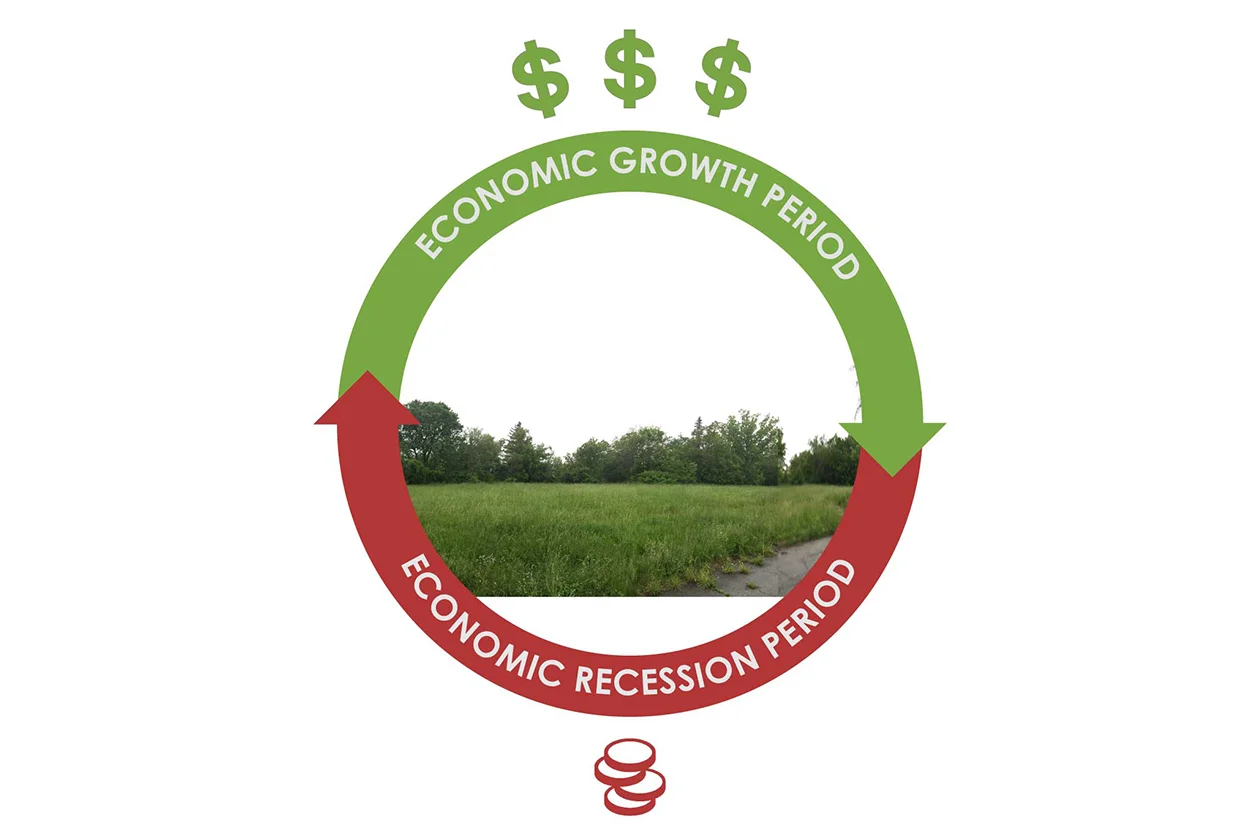
It’s important to remember that civilizations and their economies run through regular cycles of growth and recession. When the cycle comes back around for the upturn, you want to be the one standing there with the deed & title in hand. Now is the time Detroit. "Boss up and..." well, you know the rest.
We're Not Making Anymore Land

We’re not making any more land any time soon. In fact, we might actually be losing land mass due to rising sea levels in the coming decades. A great deal of the land we do have is virtually un-buildable or very difficult to build on because of its extreme terrain. This alone has made land extremely valuable throughout human history and continues to do so today. This desire is intensified in modern society with the unprecedented levels of land development seen across the globe. So for the most part, land is a non-renewable resource and those who own it will have a valuable asset at some point depending on the prosperity of an economy. It’s important to remember that economies and civilization run through cycles. When the cycle comes back around for the upturn, you want to be the one standing there with the deed.
Versatile Investment
Land is a very versatile investment. By doing the right research and finding capital you can do just about anything with it to create some needed value (code pending): turn it into a park; build a house on it; develop retail space on it; or any mixture of these. The important point is to do your due diligence first to see what the possibilities are in a specific jurisdiction. An architect can help you gather all the pertinent information. You can also develop the land into an income property. Many people build homes, apartments, townhouses, retail & office space on land and then rent that space for a profit to those in the market for such a space. In this case the land and the property serve as an enterprise, generating revenue for the owner while providing a valuable asset to their community. In contemporary neighborhoods, real estate products that have a high demand but low supply are Missing Middle buildings - structures in between single family homes and large 30+ unit apartment buildings. With these simple, revenue generating buildings types great neighborhoods were begun by everyday folks. They were private landowners developing property and then capitalizing on that space to build wealth for themselves and their family while nurturing the neighborhood. Through a good market study and an understanding of zoning laws, property owners can turn their land into a solid long term investment. It takes money to get going. But like the songwriter 'Stretch Money' says “It takes money to make money”.
More Stable Than The Stock Market. Yes, I Said It.

Most of you are thinking, “how can this be true when we just experienced one of the worst real estate housing markets in global history”. You are correct. But there is a key difference between land and stocks. When a company experiences economic loss and depression it runs the risk of closing its doors forever (as we witnessed in 2008). But when land goes through economic depression, it simply gets devalued. It never ceases to exist (unless it goes underwater). It may be worth pennies but it’s still there. Since it still exists, it forever has the ability to experience economic gains once an economy rebounds (as we are witnessing now). The bigger issue is being able to maintain the land and/or property through said depression which can prove to be difficult. However, if you can manage that until the next economic upswing, you’ll see some worth-while gains. But you MUST "flip" your thinking and play the long game.
It's a Long Term Game
I’ve noticed a contradiction. We are obsessed with the house flipping culture - the act of buying property, doing the bare minimal amount of improvements and then selling it. We even glorify it on HGTV. We do this while at the same time complaining about the conditions and services of our neighborhoods and communities. Flipping is not a bad thing when it's done correctly. It should be used as a capital raising strategy, building funds for other more substantial land developments to be built in the same neighborhood. And there is the operative word: neighborhood. Flipping a house is a good way to make relatively small amounts of quick money. It is much less effective at improving a neighborhood and the ‘flipper’ misses out on the true ROI (Return On Investment) which comes by playing the long game. What does improve a neighborhood is a commitment to place and an investment of time and money in both the individual property and its surrounding community. When the neighborhood improves, the land inside that community also improves - tremendously.

In Detroit as we speak, people from outside of the state who understand this principle are buying property cheap. A good deal are flipping. But there is equally a good deal of people that are not flipping. They’re setting up roots. They are committing the next 5, 10, 15 years of their lives to not just improving their land but also the neighborhood, because they foresee the economic upswing coming. They are fixing up their homes piece by piece. They are planting trees on the street. They are cleaning out the alleyways. They are cutting the grass on their lawns and the lawns of unoccupied adjacent properties. They are buying the abandoned corner store at the end of the block and turning it into a record shop, or market, or coffee house. They are playing the long game. They are investors in neighborhoods and not buildings. This is how land equity and economic value can be achieved. Our only wish is that people who have lived in the city for generations realize this as well and begin take advantage of the opportunity before them along side the cohort of "New Detroiters". In order to improve neighborhoods, build wealth, and live better lives we need more commitment to place. We need more long term visionaries. People who are willing to invest in property for the long term and use a little elbow grease to make their communities what they need to be. It doesn’t happen overnight. But over time you will see returns on your investment and you will have created a great neighborhood in the process.
What the Heck is Zoning?
Zoning is the process of regulating land development. This is done through a city or county zoning ordinance of some sort - a set of land laws that dictate what you as a private landowner can build on a piece of property. Knowing your zoning entitlements is the first step toward developing the home or income property of your dreams and maximizing its potential value.
Zoning is the process of regulating land development. This is done through a city or county zoning ordinance of some sort - a set of land laws that dictate what you as a private landowner can build on a piece of property. Knowing your zoning entitlements is the first step toward developing the home or income property of your dreams and maximizing its potential value.
An Extremely Brief History on Zoning
The concept of zoning has existed informally for thousands of years. The Romans purposefully focused public and civic development in the Forum, an urban space for public life right in the heart of Ancient Rome. The Athenian Greeks concentrated religious development on the Acropolis in Athens. During the Moorish & Arabic Dynasties of Southern Spain and Northern Africa, development of royal palaces was centralized like at the Alhambra in Granada, Spain. It wasn’t until 1916 that the first documented and comprehensive zoning ordinance was codified when New York City passed theirs. It was created in response to the explosion of Manhattan skyscrapers that were blocking light and air from reaching the streets. The Zoning Ordinance of 1916 established a system of setbacks and height limits which would control the shape of buildings in order to provide a better street environment for pedestrians as well as protecting the property rights of adjacent landowners. Cities across the United States and Europe would soon follow and formal land zoning as we know it today was born. In fact, most major metro areas in the United States can trace the beginnings of their zoning regulations back to the 1916 NYC ordinance.

A diagram from the 1916 NYC Zoning Resolution that required buildings in Manhattan be setback a certain distance from the street to give air and light to people on the street and adjacent property owners. This is an example of form-based zoning that many cities have mimiced.

Versions of one of New York City's most iconic skyscapers - The Chrysler Building. The form of the building is a direct responce to the city's 1916 Zoning Code and the requirement buildings be set back from the street for public benefit.

The Chrysler Building as seen from the street. As the building gets taller it has to set itself further back from the street creating the iconic stepped form.
Today there are two types of zoning codes: Use-Based Codes and Form-Based Codes. The most common is a use based code although in my opinion the most effective is a form-based code. I’ll get into the details of each in another post.
Determine your Zoning Entitlements
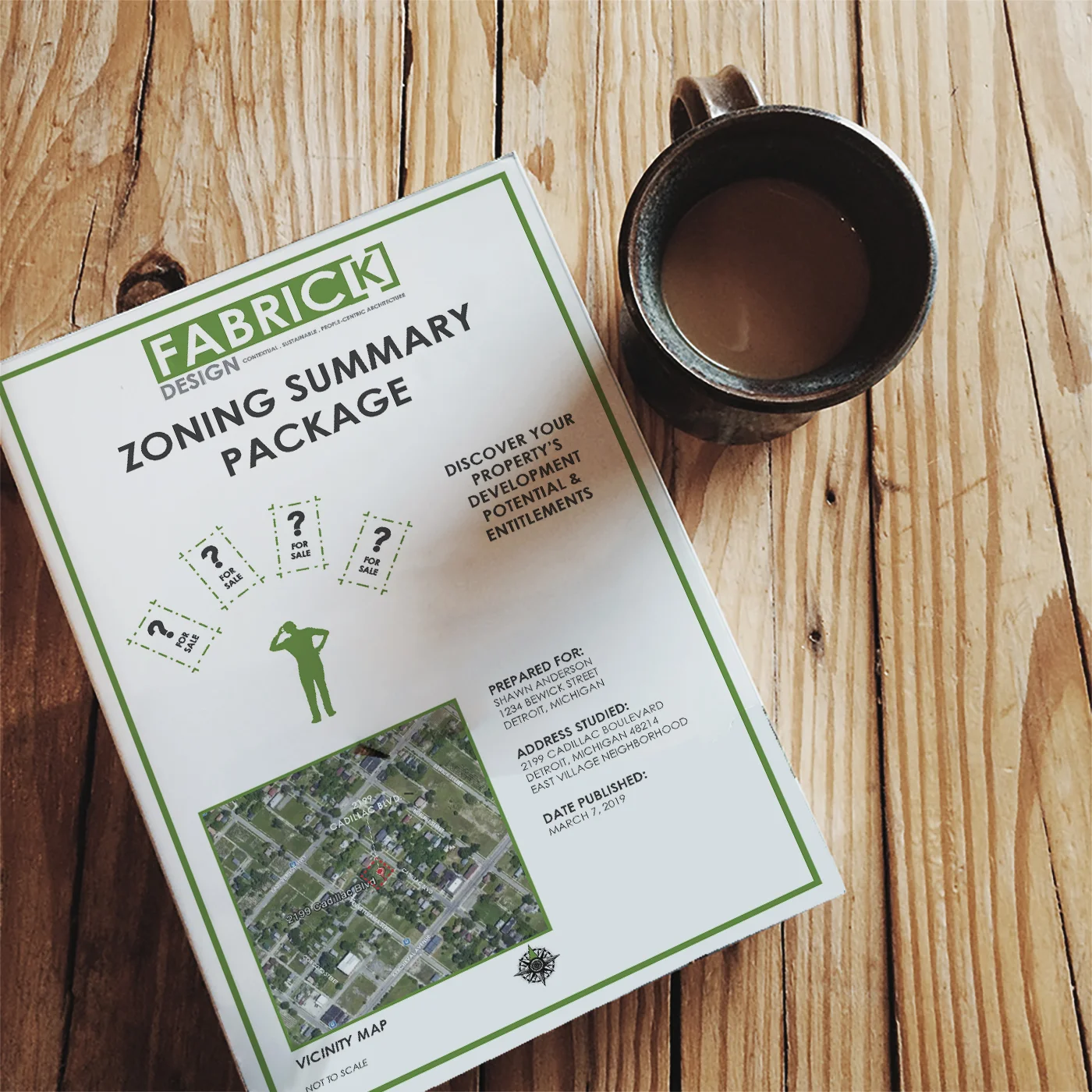
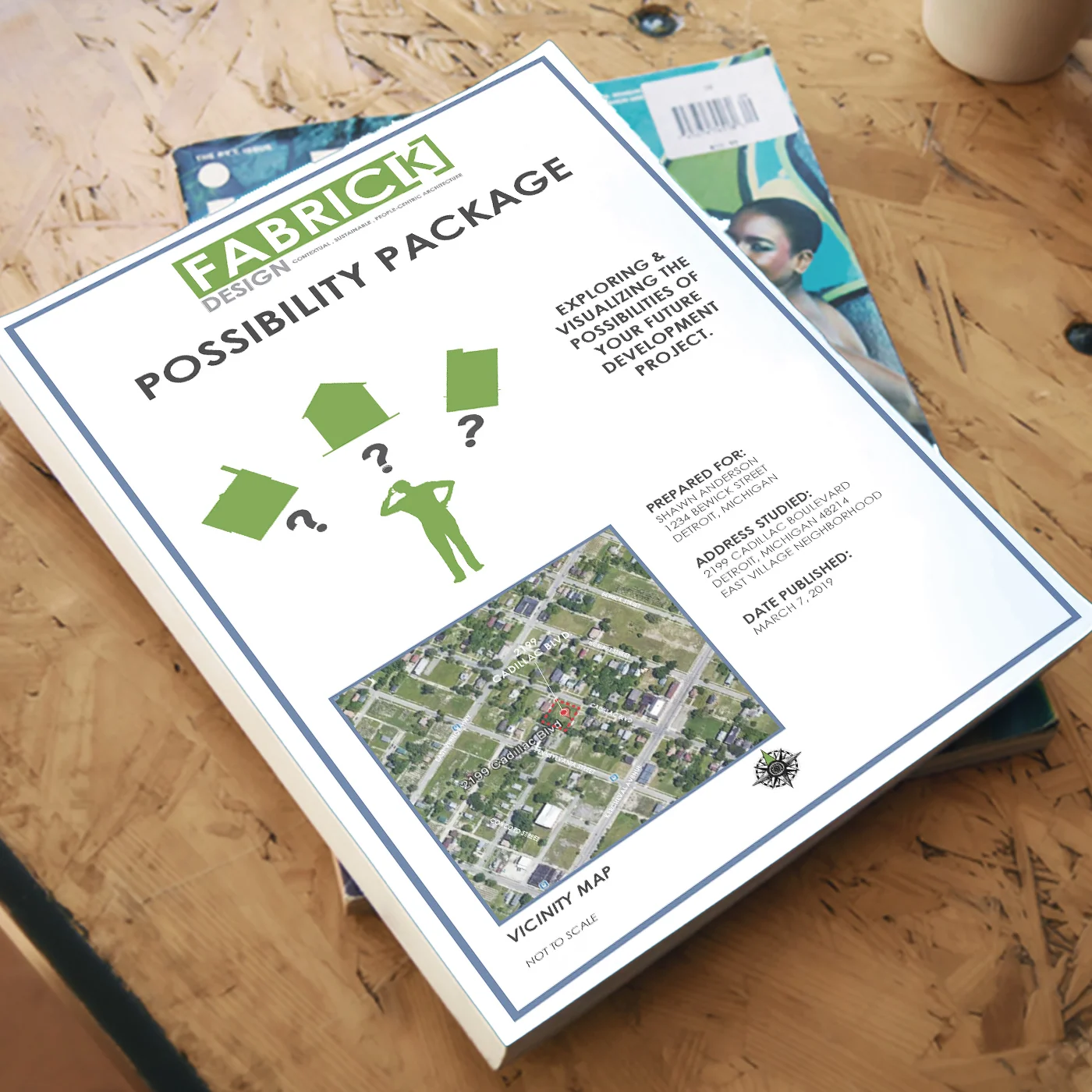
Zoning ordinances are accessible to the public. You can usually find them on your city or county website. They are often extremely long and convoluted documents. So even though they are available to the public for free, most people hire an architect or zoning attorney to interpret the text for them. Fabric[K] Design offers this service in the Detroit area, in the form of our Zoning and Possibility Packages. They are perfect products for current and future landowners who are still gathering information and flirting with the idea of a future project. It’s important to interpret the zoning code as accurately as possible from the beginning. Building an illegal, non-conforming structure on a piece of land can produce some pretty hefty fines for landowners and also waste value time.
Zoning Terms You Should Know
There are many zoning terms but here are some of the most basic ones that landowners should be familiar with…


- By Right Development - a type of development that a landowner is legally entitled to build based on the zoning ordinance. By-right development does not require any special exceptions, permits, variances or review from a Board of Zoning Appeals.
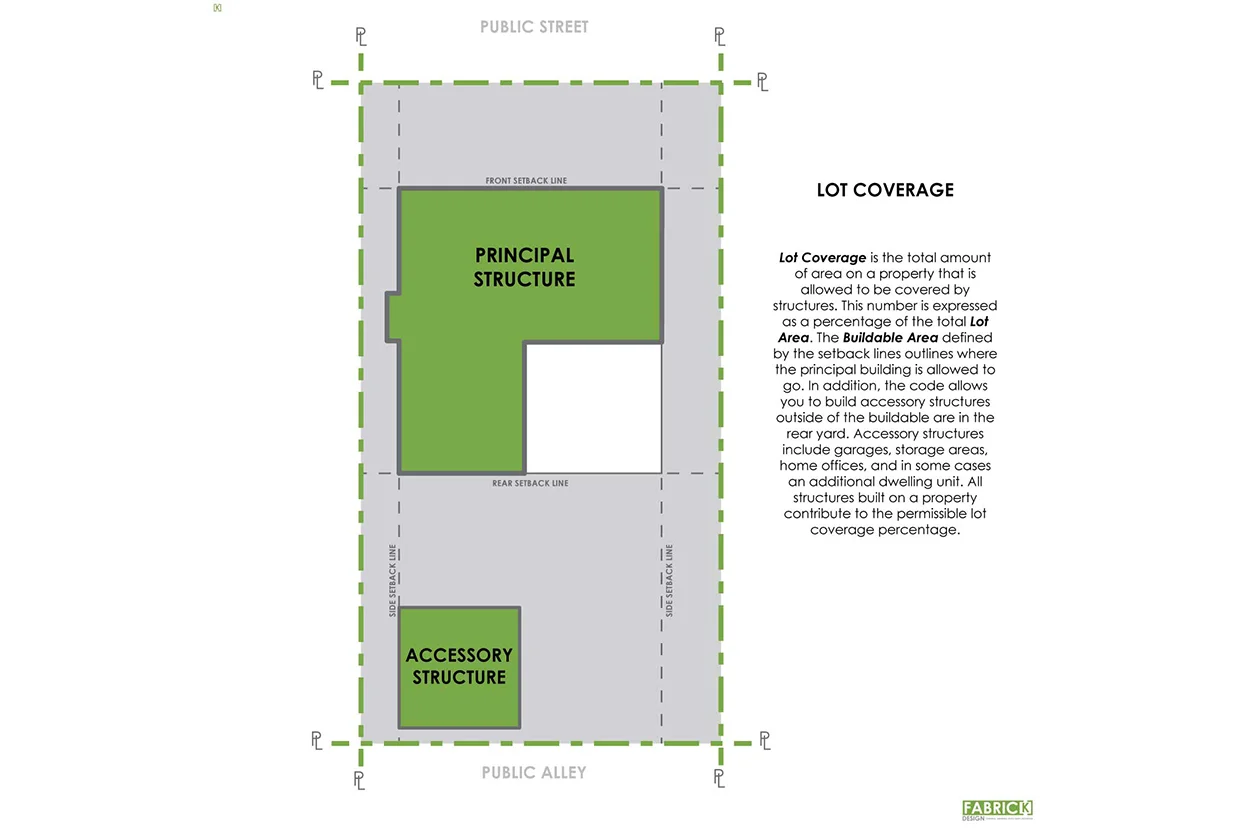
- Yard and Setback - A yard is legally defined as a the area of a property that is not covered by a principal structure. Yards are usually defined by setbacks - a horizontal distance away from a property/lot line that a building cannot go past. There are typically yards on all sides of a building defined by rear, front and side setback lines.
- Lot/property line - A line the defines the legal boundaries of a piece of property.
- Lot Area - The area that is contained within the boundaries of the lot/property lines.
- Lot Coverage - The amount of area on a lot that is allowed to be covered by a structure(s)
- FAR - the ratio of total gross floor area of all the floors of a building and the total lot area.
- Floor Area - the total floor area of a singular level within a building.
- Gross Floor Area - the total floor area of all the floors of building.
- Off Street Parking - number or spaces for vehicle parking required to be located on the property.
- Use - The purpose or activity for which land and any structures built, will be used, occupied and maintained for. Example. Residential Use.
![Building Better, More Sustainable Lifestyles: The Story of Fabric[K] Design](https://images.squarespace-cdn.com/content/v1/5846fe37ff7c5046fc8b98e8/1506839968548-MI2NKZLJ7XYQCIMYMFJA/21SEGREGATION-1-articleLarge.jpg)
Building Better, More Sustainable Lifestyles: The Story of Fabric[K] Design
The condition of the Detroit neighborhood is also the condition of the American neighborhood. The solution is complex and multifaceted. But I believe it has much to do with the design of the built environment and the relationship - or lack there of - that people have to that environment. This is the genesis of Fabric[K] Design.

Why I Started Fabric[K] Design
People in other countries live more sustainable lifestyles than we Americans do. We may have the most ‘freedoms’, the largest military, the largest GDP, and the most stable social order. But on a fundamental level, people from other countries live their lives more sustainably. They have a more intimate relationship with their natural and built environments. On average, people from certain places in Europe, Asia, India and Africa walk and bike more, helping to keep them physically fit and less obese by simply doing daily tasks. Places near the Mediterranean have better diets because they primarialy shop at produce markets, grow their own food without chemicals (although this is changing sadly), cook more, and know exactly where their food comes from. As a result, they have significantly lower cases of chronic heart conditions, cancers, and other so-called "Western Diseases". They live closer together and closer to where they work, play, and relax which gives them more time to be social, spend time with family, and be more efficient with daily tasks. Yes, we in the U.S. have more money in the bank. But these other populations have better, more sustainable and healthier lifestyles.


I’ve had the good fortune to do a bit traveling in my 30 years of life - Europe, China, Africa - and I've seen these differences first hand. American neighborhoods used to be like this. In fact I remember them vaguely as a kid growing up in Detroit. I remember playing basketball, curb-ball, or catch in the streets of my grandmother’s neighborhood on the Westside of Detroit. I remember running down the sidewalk trying to flag down the Ice Cream truck. I remember my neighborhood friends and I, racing our bikes home from the park to get there before there before the street light curfew went into effect. I remember walking a block to the corner market, to pick up some final ingredients for dinner. I remember helping my grandmother harvest her vegetables and fruits in the backyard garden. I remember evenings hanging out on the stoop with my friends after dinner. In summers, we’d stay there cracking jokes until it was time for bed. I remember the old folks in my neighborhood knowing my name as I strolled through the streets. They always looked out for me, because they knew I was Beulah’s little grandson. Sound familiar? I’m sure many of you could tell some version of this same story.


A few years ago, in the midst of my travels, I recalled these memories as I evaluated how these other cultures lived, and I compared that to the current condition of Detroit Neighborhoods and I thought to myself, “What the heck happened?” The condition of Detroit neighborhoods is actually the condition of the American neighborhood. The answer is complex and multifaceted. But I believe it has much to do with the design of the built environment and the relationship people have to that environment. This is the genesis of Fabric[K] Design.
What is Fabric[K] Design?
My name is Marques King. I was born in Detroit, Michigan. Not Metro-Detroit. Not Southeastern Michigan. The D. I left Detroit in 2012 because there were zero jobs for newly graduated architecture students. I left for Washington DC determined to learn the things I couldn't had I stayed. It was the best decision of my life. I got a masters, became licensed, became an urban designer, traveled, worked, learned languages. I lived. And now I want to bring all of those experiences, expertise, and skill back to the town that made me who I am today. Fabric[K] Design is my way of doing that. Fabric[K] Design is an architectural and urban design consultancy firm located in Detroit, Michigan. Our vision? To help people live better, and more sustainable lifestyles similar to the one’s I just described above. Our mission is to pursue this vision through contextual, sustainable and people centric design principles. In short our thesis is that neighborhood life in Detroit and in America for that matter, is broken. We want to weave it back together.


What You Can Expect From Fabric[K] Design
You can expect us to provide quality architectural design and consultantcy services for a whole range of residential and light-commercial buildings as well as neighborhood urban planning. And if you can’t tell from the stories I just told, we like to focus on neighborhoods. To learn more about us, visit our website. There you can find our complete narrative, sign up for our quarterly newsletter, view some of our projects, and learn more about the products and services we’ll be offering in the near future. Over the next few months we will be rolling out a lot of content via. website, video, blog, and social media. So be sure to follow us and all our participating platforms. We will also be slowly rolling out each one of our products and services one at a time. We’re doing this to make sure each is well calibrated and provides the exact value that it should. I would like to make a note here. At Fabric[K] we realize that architectural services can be confusing, extremely expensive, and ambiguous (check out my blog on how architects can improve). Staying true to our goal of being a people-centric company, we are working on providing pricing models that make design services more clear and accessible to you our future clients, customers and neighbors. We believe the easier we make this process for you, the better experience you’ll have and the more you’ll enjoy embarking on this journey to live a better, more sustainable lifestyle. We look forward to serving you and the citizens of Detroit’s neighborhoods. Thanks for hanging with Fabric[K], the company that holds it all together.